
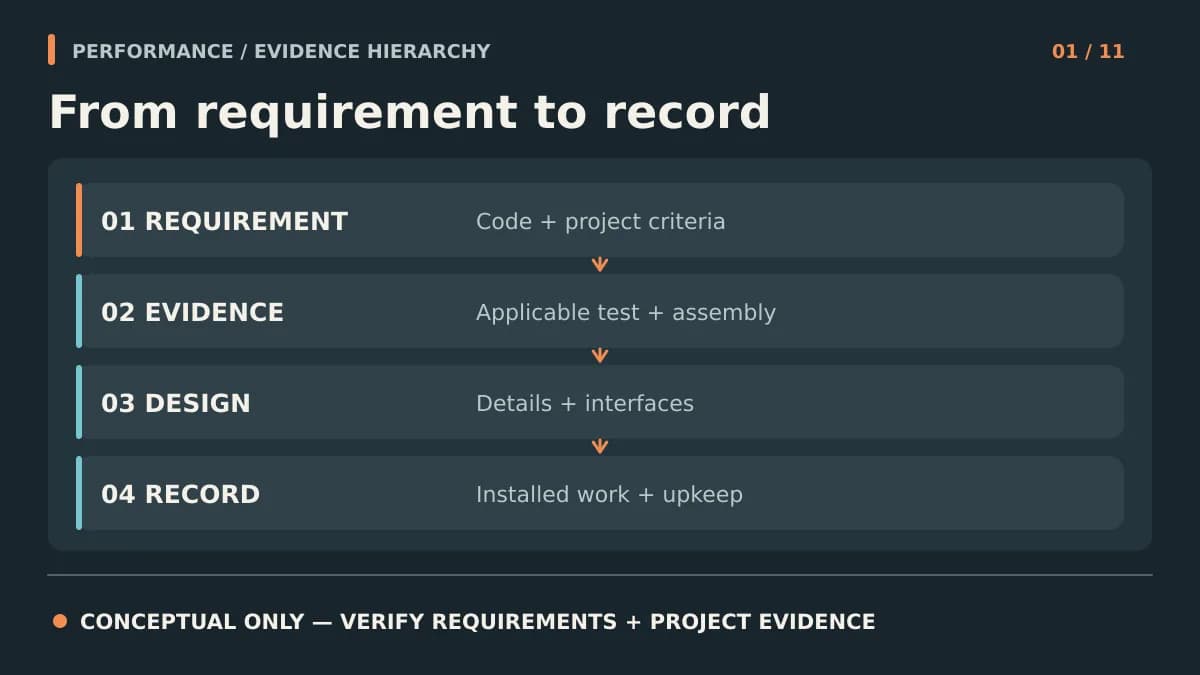
A material description is not an assembly approval. Use this guide to match each performance question to the jurisdiction, selected product, test report, and person responsible for accepting it.
Key Takeaways
- Separate broadly applicable material knowledge from the adopted local code and from evidence for the exact proposed wall assembly.
- Fire and wind results must be matched to the tested configuration and the project load path; a sample, coating label, or generic material claim cannot stand in for an assembly report.
- Choose finishes and care plans for exposure and access, then request the actual coating specification, cleaning instructions, and warranty exclusions.
- Compare environmental declarations on compatible product-category rules and declared units; model ownership costs from documented assumptions rather than an unverified lifespan.
- Ask for a dated, revision-controlled submittal package and record who resolves gaps before procurement or installation.
Aluminum cladding decisions often begin with appearance but are ultimately decided by the performance of a particular wall in a particular place. Choose the format using the exterior aluminum cladding systems guide, then treat appearance and specification planning in the architectural aluminum cladding design guide as distinct from performance approval. This guide is a verification map for architects, owners, and specifiers: identify the question, identify who sets the requirement, and request evidence that actually addresses it. It is not a code opinion, engineering design, product certification, or promise of service life. An aluminum face sheet, extruded profile, coating, anchor, cavity, insulation, and backup wall each answer different questions; the rainscreen installation and building science guide addresses control layers and installation interfaces. No one brochure can approve the assembled exterior wall. Start with three separate buckets: general knowledge about materials and tests; jurisdiction-specific requirements adopted and interpreted by the authority having jurisdiction (AHJ); and current product- and assembly-specific evidence for the selected configuration.
Build a Requirements Register Before Asking for a Certificate
At schematic design, record location, occupancy, building height, construction type, wall composition, exposure, and any local amendments. Ask the architect and code consultant to identify the adopted code edition and the AHJ's review path; do not assume that a nationally published edition automatically governs. The enclosure and structural teams should define the proposed control layers, attachment path, design wind pressures, and the boundaries of any delegated design. Record each required submittal, its owner, and the decision it supports. If the wall changes, revisit the register. A test of another insulation, weather barrier, attachment, or panel configuration may be useful background but is not automatically transferable to this one.
- General: What does the named test or standard actually measure?
- Jurisdiction: Which edition, amendments, permits, inspections, and acceptance routes apply here?
- Product evidence: Does the dated report cover this exact material, finish, support, and wall configuration?
Fire: Check the Wall, Not Just the Metal
Aluminum's material identity does not establish the fire behavior of a completed exterior wall. Coatings, cores, insulation, water-resistive barriers, cavities, attachments, and adjacent details can change what must be evaluated. NFPA 285 is a method for assessing fire propagation of exterior wall assemblies containing combustible components; whether it is required depends on the applicable code and proposed wall. The fire-test distinctions matter: do not use an ASTM E84 surface-burning result as a substitute for NFPA 285, or call a whole wall compliant because one component is described as noncombustible. Request the relevant full report or accepted evaluation, identify tested components and permitted variations, and have the design team reconcile them with the actual section and AHJ requirements.
Wind: Follow Loads Into the Backup Structure
Project wind pressure is not a property printed on a panel sample. The structural professional establishes applicable loads under the adopted standard and project conditions, including relevant component-and-cladding zones and positive and negative pressures. Review the wind-load and attachment evidence chain from cladding through clips, rails, brackets, anchors, and substrate, as well as serviceability and deflection criteria. A laboratory result for a specimen is meaningful only when its span, attachment, support, load direction, and acceptance criteria can be related to the proposed work. If calculations or testing are delegated, name the responsible designer, required seal where applicable, submittal timing, and change-control process.
Use This Matrix to Turn Questions Into Decisions
This is a request list, not a declaration that a particular Barcode product passes any criterion. The project team should add jurisdictional thresholds and acceptance criteria in the specification and track outstanding items in the submittal log.
| Decision | Authority or responsible reviewer | Evidence to request | Do not infer from |
|---|---|---|---|
| Exterior-wall fire path | Architect / code consultant / AHJ | Adopted provisions, assembly report and component-match review | Metal substrate or ASTM E84 result alone |
| Wind and attachment | Structural engineer / delegated designer | Project pressures, calculations, tests where specified, substrate and anchor details | Panel thickness or generic span claim |
| Finish and exposure | Specifier / coating supplier | Selected finish designation, coating test evidence, exposure and care guidance | Color sample or generic AAMA label |
| Local hazard and facade law | Local design team / AHJ / qualified inspector | Jurisdiction applicability, permit path, inspection scope | Another city's approval |
| Environmental comparison | Owner / sustainability consultant | Current applicable EPD, PCR, declared unit, boundaries | Recyclability statement alone |
| Ownership budget | Owner / facility manager | Warranty terms, access and maintenance plan, cost assumptions | Unsupported years-of-life estimate |
Finishes and Coastal Exposure Need Separate Review
FGIA publishes AAMA 2603, 2604, and 2605 specifications for organic coatings on architectural aluminum; the categories have different performance requirements, but a category name is not proof that every color, application process, and supplied lot conforms. Ask which finish is actually offered for the selected profile, the current specification edition, applicator documentation, and relevant test and warranty terms. In coastal climates, salt-laden air also affects fasteners, dissimilar-metal interfaces, cut edges, deposits, and the accessibility of cleaning areas. Request a project-specific corrosion compatibility review and a realistic wash/inspection plan rather than assuming that a coating specification alone solves every coastal exposure.
Check Local Rules Without Exporting Them Everywhere
Local hazards and existing-building obligations need their own track. In a Colorado wildland-urban interface project, confirm the applicable Colorado wildfire-code requirements and local adoption with the AHJ; an aluminum face does not independently establish an approved ember-resistant exterior-wall design. New York City's Local Law 11 and Local Law 97 obligations are distinct: the Facade Inspection Safety Program concerns periodic facade inspection and safety, while Local Law 97 addresses emissions for covered buildings. Neither is a generic product certificate or an automatic approval of a cladding retrofit. The project team must determine whether either law applies, how proposed work affects inspections or energy/carbon accounting, and which filings or approvals are required.
Plan Maintenance Before Claiming Durability
An owner needs an actionable cladding maintenance and repair plan: who can reach the elevation, what can be cleaned without damaging the finish, how to document impact damage or loose components, and when a qualified person investigates movement, staining, leaks, or corrosion. Ask for product-specific cleaning instructions, safe chemical and tool limitations, repair or replacement procedures, and replacement-part availability. Arrange baseline condition photographs and an accessible record of finishes and installed locations at handover. A long cleaning interval inferred from a material reputation is not a maintenance schedule. Distinguish routine housekeeping from corrective repair, enclosure investigation, and legally required facade inspections.
Service Life and Warranties Are Not the Same Metric
A service-life estimate depends on exposure, detailing, maintenance, and what counts as failure: a faded color, a damaged profile, a leaking transition, and a failing anchor are not identical events. A warranty is a contract with defined products, durations, exclusions, claim procedures, and remedies; it is not a prediction of total facade life. Request the actual written terms for the proposed finish and components, check transferability and coastal or cleaning exclusions, and ask who pays for access and labor. Do not publish an expected Barcode lifespan or warranty coverage without current applicable documentation. The owner should set inspection triggers and reserve planning even when a warranty is available.
Read EPDs as Bounded Data, Not a Green Label
An environmental product declaration (EPD) reports quantified impacts under a stated product category rule (PCR), declared or functional unit, system boundary, and publication or validity period. EPA's EPD guide describes their role in disclosing construction-product impacts. To compare cladding EPDs, check whether the documents describe the actual proposed product and comparable units and life-cycle modules; different boundaries can make side-by-side numbers misleading. Recycled content and recyclability may inform decisions but do not supply embodied-carbon figures. Ask for a current product-relevant EPD if one exists; if not, document the data gap instead of implying Barcode has a verified declaration.
Model Lifecycle Cost With Visible Assumptions
The lowest initial installed bid may not be the lowest ownership cost. Separate purchase and installation from access equipment, washing, inspection, coating repair, replacement components, interruption, and eventual removal in an aluminum cladding lifecycle-cost model. Use the owner's study period and discount-rate policy; identify who supplied every frequency and unit cost. Run more than one scenario for exposure and access because small assumptions can reverse a ranking; a comparison of aluminum and wood-composite cladding also needs consistent material-selection assumptions. Never turn a warranty duration into an assumed replacement cycle. A lifecycle-cost worksheet can clarify the decision even when uncertainty remains, provided it names that uncertainty rather than hiding it in a single payback claim.
Request a Traceable Package for the Selected Barcode Profile
Barcode's aluminum cladding panel pages and catalog are useful for identifying product families, finishes, and accessories; physical samples support appearance review. Neither the catalog nor a sample proves a listed fire rating, wind capacity, coating conformance, lifespan, or code acceptance. Send the proposed profile and finish, wall section, backup, building location, exposure, code edition, required performance criteria, and planned attachment concept to the manufacturer and design team. Ask for the current selected-profile data and installation guidance, accessory compatibility, relevant reports and limitations if available, written finish and warranty terms, and any available product-relevant EPD. Log dates, revisions, report issuers, tested configurations, deviations, and unanswered requests. If evidence is missing, mark the decision open; the responsible professionals and AHJ decide the acceptable next step before ordering.
Approval remains project-specific. Do not substitute marketing copy, a material sample, or an unrelated test report for the submittals required by the project's adopted code and specifications.
Frequently Asked Questions
Is aluminum cladding automatically code compliant because it is metal?
No. Applicable requirements depend on the adopted code, jurisdiction, building, and complete wall assembly. Ask the project code professional to identify the requirements and check evidence for the proposed configuration.
Does ASTM E84 establish that a wall passes NFPA 285?
No. ASTM E84 addresses surface burning of a tested material; NFPA 285 evaluates fire propagation of a particular exterior wall assembly. One result does not replace the other when assembly testing is required.
Can a manufacturer's generic wind rating set clip spacing?
No. Project pressures, panel spans, clips, rails, anchors, and substrate need a coordinated load-path review. Request calculations and applicable test evidence tied to the selected installation.
Does an AAMA 2605 finish guarantee a lifetime of coastal performance?
No. Confirm the actual coating's documented conformance, environmental limitations, cleaning instructions, fastener compatibility, and written warranty. There is no universal service-life promise from a finish designation.
What if an EPD or assembly report is not available?
Record the gap and request a product-specific response. The owner and qualified design team must decide whether another documented compliance or procurement path is acceptable; do not replace missing evidence with an assumed certification or impact number.
Sources & Further Reading
- NFPA — NFPA 285 Standard Development
- ICC — 2024 IBC and NFPA 285 Fire Safety Evolution
- ASCE — ASCE/SEI 7 Minimum Design Loads
- FGIA — Updated Suite of Finishes Documents for Aluminum Extrusions and Panels
- U.S. EPA — EPD Basics: A Manufacturer's Guide
- Colorado DFPC — Colorado Wildfire Resiliency Code
- NYC DOB — Facade and Local Law
- NYC DOB — Local Law 97 Greenhouse Gas Emissions Reduction

About the author
Jay Zdun
Founder, Barcode Cladding
Jay Zdun is the founder of Barcode Cladding. He specializes in aluminum façade systems and helps architects, builders, and property owners evaluate profiles, finishes, and installation considerations for modern exterior projects.
Connect on LinkedIn