
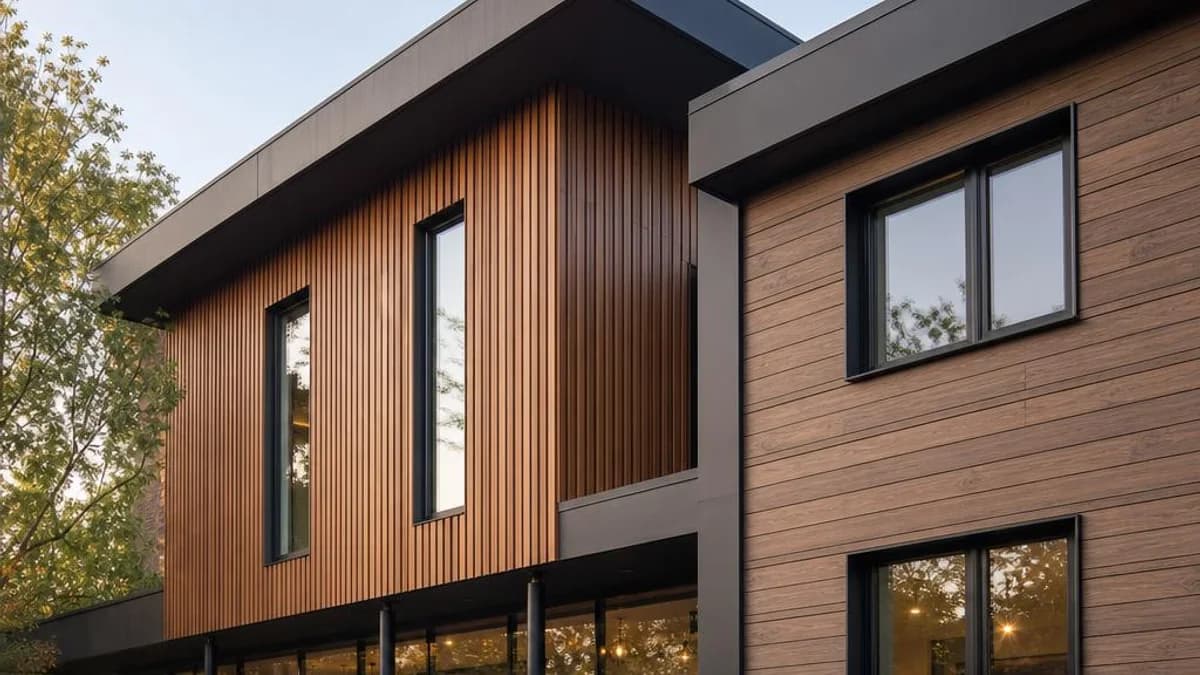
Wood-composite cladding can provide texture and a warm material story without being natural wood siding. Aluminum can deliver a wood-referential appearance or a clearly metallic one. The responsible choice depends on the exact composite formulation, exposure, assembly, fire evidence, maintenance plan, and visual priority.
Key Takeaways
- Wood-composite is a category, not one recipe; fiber type, polymer or binder, cap layer, additives, geometry, and installation rules vary.
- Aluminum can provide consistent wood-look finishes or honest metal expression, while composites may offer texture and material depth that should be assessed full-size.
- Moisture behavior, thermal movement, fire evidence, attachment, span, fading, staining, cleaning, and replacement all require product-specific review.
- Lifecycle claims should use supplier documentation, realistic maintenance scenarios, and project service conditions—not assumptions about either category.
The Short Answer
Choose aluminum when lightweight profiles, crisp geometry, a controlled finish, or metal's nonabsorptive substrate supports the concept. Consider wood-composite when its particular texture, composition, profile, and maintenance model fit the project. This article addresses manufactured wood-based or wood-plastic composite cladding—not natural wood siding—and the exterior aluminum cladding systems guide describes the aluminum formats relevant to this choice.
Define Wood-Composite Before Comparing It
Wood-composite may describe wood-plastic composite, capped composite, engineered wood fiber with a binder, or another proprietary formulation. These products do not share identical moisture response, fire characteristics, spans, expansion, coatings, or end treatments. Request a technical data sheet, safety information, installation instructions, test reports, and finish or fade terms for the exact product.
Specification Decision Table
The table highlights information to verify with actual submittals and samples.
| Criterion | Architectural aluminum | Wood-composite cladding |
|---|---|---|
| Visual character | Metallic, solid-color, anodized, or printed wood-look finish | Wood-derived texture or embossed/capped manufactured surface |
| Moisture | Does not absorb water; wall still needs drainage and compatible details | Response varies by formulation; ends, clearances, ventilation, and wetting limits may matter |
| Movement | Thermal movement addressed by joints and clips | Thermal and moisture-related movement varies; follow product limits |
| Fire review | Metal substrate, but evaluate coatings and complete assembly | Verify exact formulation, flame-spread data, and assembly requirements |
| Maintenance | Clean and inspect finish, joints, flashings, and damage | Clean and inspect for finish change, staining, moisture effects, and damage per instructions |
| Submittal focus | Alloy, profile, thickness, finish, attachment, and engineering | Composition, profile, span, attachment, clearances, exposure, and test evidence |
Appearance: Authentic Texture or Controlled Repeatability
Composite products may provide tactile grain and color variation; aluminum wood-look finishes can offer repeatable color on slender, precise profiles without claiming to be natural timber. Unlike manufactured composite, natural wood siding brings its own grain, patina, and maintenance considerations. Review multiple full-length pieces to see pattern repetition, embossing, sheen, end appearance, and batch variation. Build corners and window returns in the mockup because accessories can change the perceived authenticity more than the field material.
Moisture, Movement, and Ventilation
Aluminum does not swell from moisture absorption, but water still must drain behind it and dissimilar contacts need review. Some composites change dimension with temperature, moisture, or both; behavior depends on formulation and profile. Respect ground and roof clearances, end sealing where required, support spacing, ventilation instructions, butt-joint gaps, and limits on enclosed or high-moisture locations.
Fire Is a Product-and-Assembly Question
Do not infer fire performance from the presence of wood fiber, plastic, or aluminum alone. Request current evidence for flame spread, heat release, ignition, and exterior-wall assembly requirements applicable to the product and building. Insulation, membranes, cavities, barriers, fasteners, and geometry also matter. A Barcode aluminum profile—or any competing cladding—must be reviewed within the proposed assembly and jurisdiction.
Lifecycle and Responsible Comparison
A credible cladding lifecycle review defines a study period and includes quantity, waste, transport, subframing, coatings, cleaning, repairs, refinishing if required, replacement, and end-of-use assumptions. Ask for product-specific environmental declarations or transparent ingredient and recycled-content information where available. Recyclability in theory is not the same as local recovery in practice, and no unsupported lifespan should be inserted into the specification.
Best-Fit Recommendations
Aluminum is a good candidate for commercial façades needing slender lines, concealed attachment, nonabsorptive material, and consistent finish control; Barcode's wood-look and solid-color aluminum profiles offer physical options to compare. Wood-composite can be a good candidate where tactile warmth and the chosen product's material composition justify its detailing and maintenance. For mineral boards, aluminum versus fiber cement cladding requires different installation and safety criteria.
Frequently Asked Questions
Is wood-composite cladding the same as natural wood siding?
No. It is a manufactured product that combines wood fiber or flour with polymers, binders, caps, coatings, or additives depending on the formulation. Its installation and performance data are product-specific.
Can aluminum cladding look like wood?
Yes. Decorative finish processes can reproduce wood-referential color and grain. Review full-length samples for pattern scale, repetition, sheen, and corner treatment rather than expecting it to duplicate natural timber exactly.
Will wood-composite cladding absorb water?
The answer varies by formulation and cap or coating. Consult technical data and installation instructions for absorption, edge treatment, ventilation, clearance, storage, and wet-service limitations.
Which has the lower environmental impact?
No category-level answer is reliable. Compare product-specific declarations, composition, quantity, transport, expected maintenance, replacement scenarios, and realistic end-of-use routes for the project location.
Sources & Further Reading

About the author
Jay Zdun
Founder, Barcode Cladding
Jay Zdun is the founder of Barcode Cladding. He specializes in aluminum façade systems and helps architects, builders, and property owners evaluate profiles, finishes, and installation considerations for modern exterior projects.
Connect on LinkedIn