
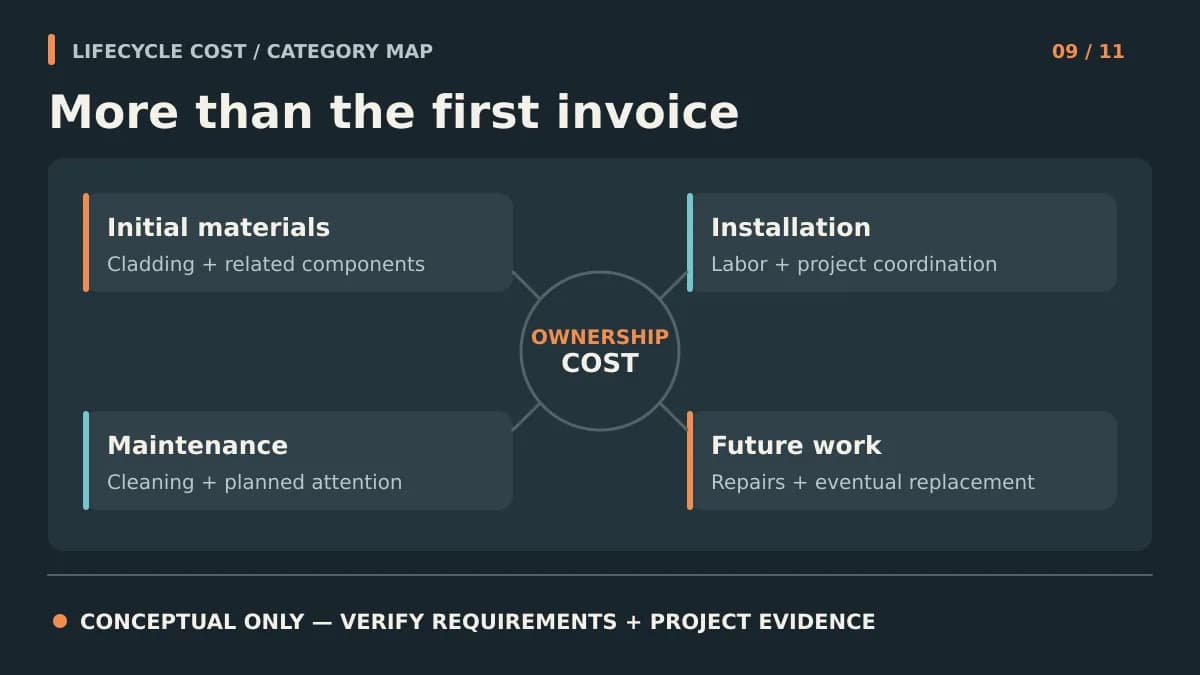
The lowest purchase price is not always the lowest ownership cost. A transparent comparison names the wall scope, study period, maintenance work, replacement assumptions, and uncertainty.
Key Takeaways
- Compare equivalent installed wall scopes, not a panel-only price against a complete façade bid.
- Include realistic cleaning access, inspections, repairs, replacement, and disposal rather than labeling any material maintenance-free.
- State study period, discount convention, price basis, and uncertainty; test the assumptions that drive the result.
- Treat warranty terms and visual samples as separate inputs: neither establishes total ownership cost.
First-cost comparisons often stop at the material quote, even though cladding decisions also set access, cleaning, replacement, and repair demands for decades. A life-cycle cost analysis (LCCA) compares alternatives over a defined study period by assigning costs to when they occur and translating them to a consistent present-value basis within the wider cladding performance, codes, and lifecycle decision process. The Whole Building Design Guide explains why initial, operating, maintenance, replacement, and residual values belong in that framework. This guide is a planning method, not a Barcode pricing estimate or a claim that one material always wins.
Draw the Same Boundary Around Every Option
Start with an equivalent area and performance requirement, including the selected panel, finish, trims, support, attachment, openings, drainage and water-control interfaces, installation labor, waste, and access equipment. Some items may be common across bids; document them instead of silently leaving them out of one option. Separate base-building items from alternate-specific costs so that the comparison does not charge one candidate for work all candidates require. Note whether the bid includes design review, testing, mockups, warranties, and closeout documents. An attractive per-panel price may say little about the complete installed wall.
- Use the same elevation, openings, assumed backup, and required performance.
- Request itemized installed quotes with exclusions and alternates.
- Identify who pays for access, mockup, replacement stock, and disposal.
- Carry common-wall costs consistently or exclude them consistently.
Model Costs When They Actually Happen
Choose an owner-approved analysis horizon, base date, inflation and discount convention using a consistent present-value framework. Enter initial expenditure at procurement, then place inspections, cleaning, sealant or flashing interventions, repairs, anticipated replacements, and end-of-period residual or disposal amounts in appropriate years. Do not multiply annual cleaning costs by an arbitrary number of years without checking frequency, access method, escalation, and discount treatment. NIST Handbook 135 is a federal energy-investment manual, not a cladding cost schedule, but its present-value discipline is useful for structuring comparisons. Ask the owner's estimator to confirm the financial assumptions.
Choose Assumptions That Can Be Audited
Use actual project estimates where possible, and flag assumptions where evidence is absent. A finish warranty does not eliminate all costs of inspection, access, investigation, labor, or excluded damage. A service-life estimate is not a guaranteed replacement date. Maintenance needs vary with climate, elevation, pollution, and nearby surfaces. Build low, central, and high cases for uncertain events instead of pretending to know a precise future invoice. The decision table below helps the team ask for the right evidence before entering a value in the model.
| Cost category | Evidence to request | Sensitivity to test |
|---|---|---|
| Installed first cost | Comparable itemized bids and access plan | Subframe or labor changes |
| Routine care | Finish instructions and building access estimates | Cleaning frequency and equipment |
| Repair and replacement | Component access detail and contractor allowance | Timing, area, and finish matching |
| End of study | Residual-value and disposal assumptions | Whether work falls just outside horizon |
Keep Financial and Environmental Models Distinct
Lifecycle cost is measured in money, while an EPD reports environmental indicators within defined boundaries. A low-cost option is not necessarily low-carbon, and a low embodied-carbon number is not a discounted financial value. The two can share consistent quantities, service-period assumptions, and replacement scenarios, but should not be collapsed into a single unsupported “sustainability payback.” Also test nonfinancial constraints: a wall that cannot satisfy project code or enclosure requirements is not a viable low-cost alternative. Record which professional validated performance before comparing only the remaining feasible choices.
Use the Model to Ask Better Procurement Questions
Show the total and the cost by category, then change the uncertain assumptions one at a time. If the ranking reverses when cleaning access changes, investigate that access plan and the actual maintenance and repair work. If one replacement event dominates, review replaceability with the detailer and contractor; keep modeled renewal separate from contractual warranty coverage. If two alternatives are close, present a range rather than false precision. Keep both nominal and discounted totals labeled so a future reader can reproduce the comparison, and record the source and date of each quoted amount. Revisit the model when the wall geometry or support approach changes; quantities derived from a schematic layout are not procurement quantities. When comparing aluminum and fiber cement cladding, use the same wall scope. For Barcode, request selected-profile and finish information, project pricing, available written terms, and care instructions before entering brand-specific figures. Finish samples establish appearance only; they do not validate lifetime costs or tested assembly performance.
Frequently Asked Questions
Is aluminum cladding always cheaper over its lifetime?
No universal ranking is defensible. Installed systems, finish, access, maintenance, repairs, discount assumptions, and study periods vary by project.
Should a warranty remove replacement costs from the model?
No. Read actual covered defects, remedies, exclusions, and labor or access terms; model uncovered risks and test different scenarios.
What study period should an owner use?
Use a period appropriate to the owner's decision and consistently applied to every alternative. Explain replacement and residual-value treatment at the period's end.
Can an EPD substitute for a lifecycle-cost estimate?
No. An EPD describes environmental impacts under defined rules; LCCA models costs over time. They may share quantities but answer different questions.
Sources & Further Reading
- WBDG — Life-Cycle Cost Analysis (LCCA)
- NIST / WBDG — Life-Cycle Costing Manual for the Federal Energy Management Program, Handbook 135
- EPA / WBDG — Facility Service Life Requirements

About the author
Jay Zdun
Founder, Barcode Cladding
Jay Zdun is the founder of Barcode Cladding. He specializes in aluminum façade systems and helps architects, builders, and property owners evaluate profiles, finishes, and installation considerations for modern exterior projects.
Connect on LinkedIn