
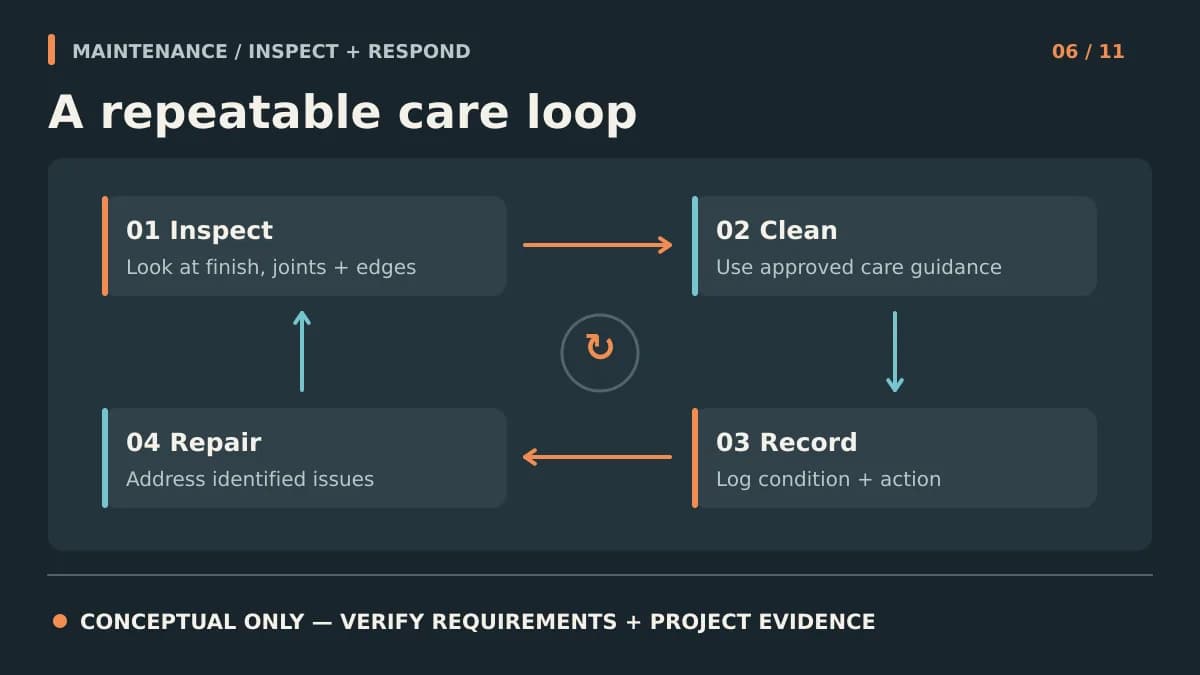
The right maintenance plan protects both the appearance of the panels and the hidden water-management details. Start with the actual finish and exposure, not a universal cleaning recipe.
Key Takeaways
- Obtain care instructions for the installed finish and test the proposed cleaning method in an inconspicuous area before broad use.
- Inspect flashings, joints, outlets, connections, and coating condition separately; a clean panel is not proof of a healthy wall.
- Escalate corrosion, coating damage, loose panels, and persistent water staining for diagnosis before cosmetic repairs.
- Keep dated records of conditions, cleaning agents, repairs, and follow-up to support future decisions and any warranty inquiry.
Architectural aluminum generally avoids the rot and insect issues associated with some other claddings, but it is not maintenance-free. Dirt, salt, runoff, damaged coatings, and problems at adjacent wall details still demand attention. Within the cladding performance, codes, and lifecycle framework, a useful owner plan separates finish care from enclosure inspection: washing addresses surface deposits, while inspection looks for water-management and attachment concerns. The current FGIA AAMA 609 & 610-25 guide covers cleaning after construction and subsequent periodic care of painted and anodized architectural aluminum; it is a reference for selecting a method, not a substitute for instructions for the finish actually installed.
Establish a Baseline at Handover
Ask for the installed finish identification, the finish supplier's current care instructions, approved shop drawings, closeout photographs, warranty documents, and a map of elevations. Record any pre-existing marks before a cleaning contractor arrives. Also document nearby materials that may drain onto the face: concrete, masonry, sealants, roof edges, and landscape irrigation can create very different deposits. A physical color sample is helpful for comparing appearance, but it cannot establish coating chemistry, cleaning compatibility, or warranty coverage. Assign one party to hold the records so future facilities staff do not have to reconstruct them from invoices.
- Identify finish type and manufacturer before selecting cleaner.
- Photograph representative elevations and already-damaged locations.
- Identify safe access methods and the party authorized to approve work.
- File the care and warranty documents with the as-built wall details.
Choose Cleaning by Finish, Deposit, and Exposure
Begin with the gentlest approach permitted by the applicable finish guidance, including the FGIA AAMA 609 & 610-25 cleaning guide, and trial it in a discreet location. Confirm dilution, dwell time, rinse water, equipment, and protection of neighboring materials with the finish supplier. Do not assume that a solvent, abrasive pad, strong alkaline cleaner, acid, or pressure-washing setting suitable for one coating is safe for another. Likewise, do not prescribe a single interval for every elevation: sheltered soffits, busy street fronts, and salt-exposed faces accumulate different contaminants. Plan inspections after unusual events as well as routine visits. If an unknown stain persists, identify its source before escalating chemicals.
Inspect Beyond the Visible Finish
Walk the elevations for coating changes, impact marks, dents, corrosion indications, staining patterns, movement at joints, open sealant transitions, looseness, and blocked drainage outlets. Note whether a stain begins above a window, at a fastener, or from another material: its origin can be more important than its appearance. Do not conceal a recurring leak with a touch-up. Where access is limited, prioritize high-risk interfaces and arrange a qualified enclosure review. Inspection frequencies and safe-access plans must reflect the building, climate, ownership requirements, and actual wall design rather than an unsupported universal schedule.
| Observed condition | First decision | Who to involve |
|---|---|---|
| Routine soil without coating failure | Confirm finish instructions; trial gentle cleaning | Facilities and finish supplier |
| Scratch or local coating damage | Photograph, identify substrate exposure, request approved repair method | Finish supplier and architect |
| Recurring stain or wet backup | Trace water source before cosmetic treatment | Enclosure professional |
| Loose panel or displaced trim | Restrict access below; investigate attachment | Qualified attachment designer / contractor |
Treat Repairs as a Diagnosis, Not a Paint Job
Damage may be limited to a finish, or it may involve the panel, attachment, or water-control layer behind it. Do not prescribe an improvised touch-up coating or substitute fastener without checking the chosen system and repair requirements. Photograph the condition, note the elevation and date, preserve representative evidence, and determine whether a local finish repair, component replacement, or enclosure repair is appropriate. For a replacement panel, confirm current profile compatibility, intended finish appearance, and whether a batch difference will remain visible. Record any removal and reinstallation work against approved project details, distinguishing service-life planning from warranty remedies.
Make the Plan Useful to the Next Owner
Log the inspection date, elevation, photos, products used, test area, contractor, repair authorization, and the next check. Update the maintenance plan when a recurring condition or changed coastal exposure warrants it. Keep cleaning operations separate from any structural or enclosure diagnosis: a surface may look renewed while a drainage outlet remains blocked. Assign follow-up dates to outstanding issues and compare photographs from the same viewpoint over time. After severe weather or work by another trade, check locations where equipment or new penetrations might have damaged the cladding. Budget for safe access before the problem is urgent: an inaccessible wall can turn a modest repair into a larger project. Inherit the records established by installation quality control. For Barcode projects, verify the installed profile and obtain selected-finish care information in technical review; no generic Barcode cleaning interval, field repair recipe, or coating warranty is assumed here. Product samples help the design team judge appearance only.
Frequently Asked Questions
How often should aluminum cladding be cleaned?
There is no universal interval. Set a schedule from the installed finish supplier's instructions, exposure, accessibility, local deposits, and inspection findings; reassess it if conditions change.
Can any household cleaner be used on powder-coated aluminum?
No. Obtain the applicable finish guidance and trial the proposed cleaner in an inconspicuous area. Avoid assuming that an abrasive, strong chemical, or pressure setting is compatible.
Can a scratch simply be painted over?
Not automatically. Identify the finish, depth of damage, substrate condition, and approved repair procedure first. A repair may be visually different and may affect warranty handling.
Does washing the cladding fix water staining?
It can remove some visible deposits, but repeated staining calls for investigation of runoff, joints, flashing, drainage, or another source before cosmetic treatment.
Sources & Further Reading
- FGIA — AAMA 609 & 610-25 Cleaning and Maintenance Guide for Architecturally Finished Aluminum
- NIBS — Building Enclosure Commissioning Process, Guideline 3-2012

About the author
Jay Zdun
Founder, Barcode Cladding
Jay Zdun is the founder of Barcode Cladding. He specializes in aluminum façade systems and helps architects, builders, and property owners evaluate profiles, finishes, and installation considerations for modern exterior projects.
Connect on LinkedIn