
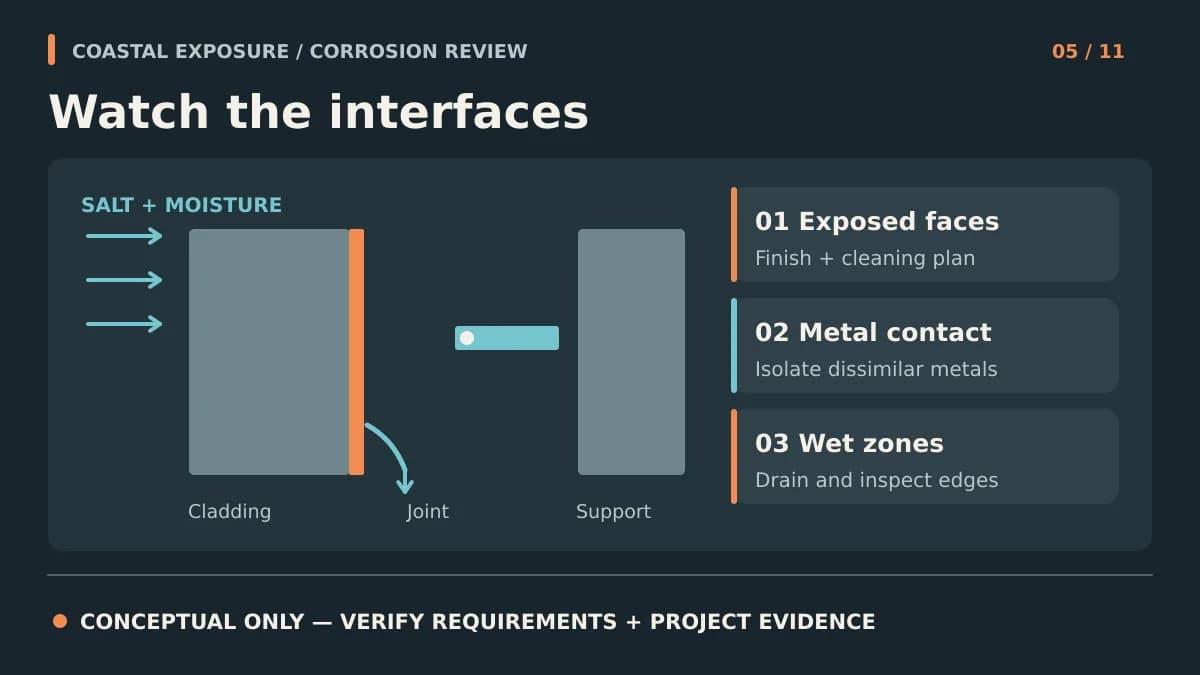
Coastal durability is a complete-system decision. Salt exposure, sheltered surfaces, metal contacts, drainage, and access matter as much as the panel finish.
Key Takeaways
- Aluminum's protective oxide does not make a complete coastal façade corrosion-proof or maintenance-free.
- Select finish and connections for project-specific salt, moisture, wind, and cleaning exposure.
- Avoid sustained salt traps and evaluate dissimilar-metal interfaces and concealed fasteners.
- No fixed distance from shore, universal wash interval, or supplier claim replaces a site-specific exposure assessment.
The coastal question is not simply whether aluminum “rusts.” It does not form red iron rust, but salt, wet/dry cycling, scratches, crevices, and contact with other metals can still damage a façade system. An exposed beachfront parapet and a sheltered wall a few miles inland may experience very different deposits. Start by mapping the actual exposure and accessibility of every elevation rather than prescribing one “marine grade” label for all projects. Apply the performance, codes, and lifecycle evidence workflow rather than unsupported product-specific certification or lifespan assertions.
Why Salt and Geometry Work Together
Marine aerosols deposit chloride-bearing salts on exposed and sheltered surfaces. Rain can wash an open face, while soffits, recessed joints, and undersides may retain deposits longer. Standing water at ledges, failed drainage cavity paths, and poorly accessible cavities increase exposure time. Aluminum naturally forms a protective oxide, but that fact alone does not guarantee the performance of an applied finish, a cut edge, a clip, or a mixed-metal connection. The enclosure designer should map water paths and preserve access for inspection rather than depending on the outer screen to remain perfectly dry.
Decision Table: Coastal Exposure Review
The table separates hazards that often get bundled into one vague “coastal rating.” A paint test is not a wind test; a strong panel is not a corrosion-resistant connection. Record assumptions for each elevation, particularly concealed elements that cannot be inspected without removing cladding.
| Condition | Potential concern | Document or detail to request | Action |
|---|---|---|---|
| Sheltered soffit or recess | Salt accumulation without rain rinsing | Finish care instructions and access plan | Inspect and clean as conditions require |
| Clip, rail, or fastener interface | Dissimilar-metal corrosion or loss of protection | Compatible material schedule and isolation detail | Have engineer review whole connection |
| Horizontal ledge or blocked outlet | Persistent wet deposits | Drainage and flashing section | Provide a maintainable discharge route |
| High-wind waterfront elevation | Pressure and suction at edges | Project wind schedule and attachment evidence | Check structural load path separately |
Evaluate Finishes With the Correct Evidence
For organic coatings on architectural aluminum, FGIA publishes AAMA 2603, 2604, and 2605 performance specifications. Select a documented system and applicable edition based on design expectations and exposure; do not claim that Barcode's standard finish meets a tier without current finish-specific evidence. Anodizing calls for its own specification and documentation rather than an organic-coating classification. Ask the finish supplier about pretreatment, edge conditions, repair procedures, allowable cleaners, and warranties. A small physical sample can prove color and texture to the design team but cannot prove coastal corrosion resistance.
Detail Fasteners and Interfaces Deliberately
FEMA's coastal fastener bulletin explains that corrosion exposure varies by location and that dissimilar-metal contact can create galvanic corrosion when an electrolyte is present. Although its primary context is metal connectors and fasteners in coastal flood-hazard construction, the mechanism is relevant to façade connection review; do not treat it as a certification of a cladding assembly. Ask a qualified engineer to select and detail compatible fasteners, rails, anchors, washers, and isolation where needed. Neither “always use 316 stainless” nor “always use aluminum” is a universal substitute for strength, substrate, and galvanic review.
Drain, Inspect, and Maintain
Detail flashings, outlet paths, penetrations, edges, and transitions so water can leave the wall. Do not assume an open-looking joint supplies adequate drainage if blocking, sealant, or framing stops the route behind it. Establish inspection points for visible coating damage, water retention, stained fasteners, and clogged outlets within the cladding cleaning and repair plan. FGIA's AAMA 609 & 610 guide addresses cleaning architecturally finished aluminum, but the actual finish manufacturer's instructions should govern compatible methods. Avoid promising that an annual wash will suffice everywhere: the frequency depends on local deposits, rainfall, access, and the finish warranty.
A Project-Specific Submittal Checklist
Ask for the exact panel and finish identification, current coating or anodizing evidence, fastener and subframing material schedule, water-management details, project wind pressure and attachment analysis, cleaning instructions, and written warranty terms. Review whether edge cuts, drilled holes, and replacement pieces have documented treatment. Then compare the proposed details with the site exposure and keep approved records for operations staff. If information is missing, mark it for resolution by the supplier, enclosure consultant, engineer, or authority with responsibility for that question. No product-family overview or photograph should be mistaken for tested coastal performance. Include a plan for safe access to sheltered surfaces and drains. Photograph representative joints at closeout and note recurring staining or finish damage in later inspections. Early diagnosis is generally more useful than waiting until a connection is concealed behind irreversible repairs.
Frequently Asked Questions
Is aluminum cladding maintenance-free near the ocean?
No. Aluminum resists red rust, but finishes and connections still need exposure-appropriate inspection and cleaning; frequency should follow actual conditions and finish instructions.
Does AAMA 2605 certify a complete coastal façade?
No. It is an organic-coating specification, not an approval of drainage, fasteners, subframing, wind resistance, or the whole wall.
How close to shore does a building need special detailing?
There is no reliable universal mileage cutoff. Assess airborne salt, wind, rainfall, sheltering, and maintenance access at the actual site.
Do coastal product samples demonstrate corrosion resistance?
No. They demonstrate appearance. Request relevant finish-specific reports and project-specific connection details for performance review.
Sources & Further Reading
- FEMA — Technical Bulletin 8: Corrosion Protection for Metal Connectors and Fasteners in Coastal Areas
- FGIA — AAMA 2605 Organic Coating Specification
- FGIA — AAMA 609 & 610-25 Cleaning and Maintenance Guide for Architecturally Finished Aluminum
- ASCE — ASCE/SEI 7-22 Chapter 30, Wind Loads: Components and Cladding

About the author
Jay Zdun
Founder, Barcode Cladding
Jay Zdun is the founder of Barcode Cladding. He specializes in aluminum façade systems and helps architects, builders, and property owners evaluate profiles, finishes, and installation considerations for modern exterior projects.
Connect on LinkedIn