
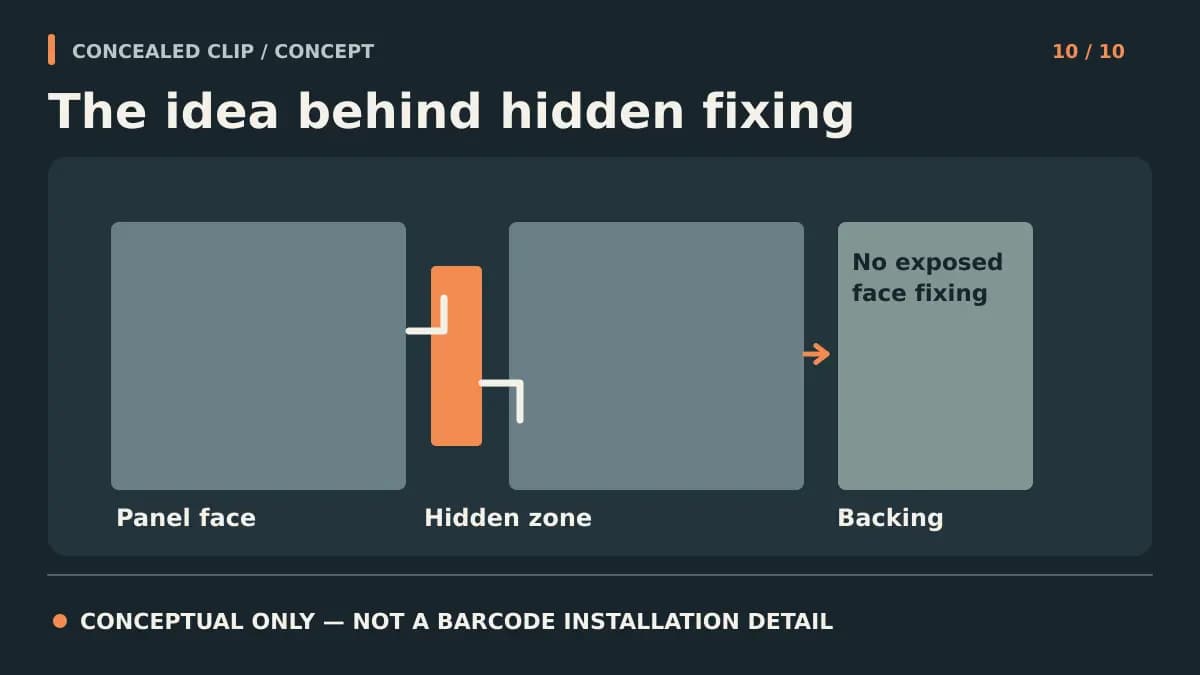
Concealed attachment keeps fasteners out of the visible panel face, but the clip alone does not specify the load path, movement allowance, drainage plane, or panel-removal procedure.
Key Takeaways
- A concealed clip connects a selected panel to its designed support without a visible face fastener; its engagement geometry is product-specific.
- Do not infer clip spacing, backing suitability, or fastener schedule from a marketing illustration.
- Movement and removability depend on the selected profile, clip design, restraint points, and surrounding courses or trims.
- The concealed fastener is not the air barrier, water-control layer, flashing, or proof of a pressure-equalized wall.
Anatomy of a Selected Concealed-Clip Assembly
Panel Engagement and Clip-to-Support Connection
The selected panel, clip and support must form a documented pairing, not simply resemble the parts in a photograph. Barcode's public catalog identifies panel and clip accessory families, but a current revision-controlled compatibility drawing was not available for this article. Accordingly, the diagram below is an evidence checklist—not an actual approved Barcode clip geometry. Resolve catalog/technical-page discrepancies directly with the supplier before repeating dimensions or ordering parts.
Record the panel profile ID, clip part number and revision, permitted orientation, engagement requirement, fastener specification and support material on one detail. Then trace two separate interfaces: the clip retaining the panel and the fastener securing the clip to its support. Neither interface proves the capacity of the support's anchors into the backup wall.
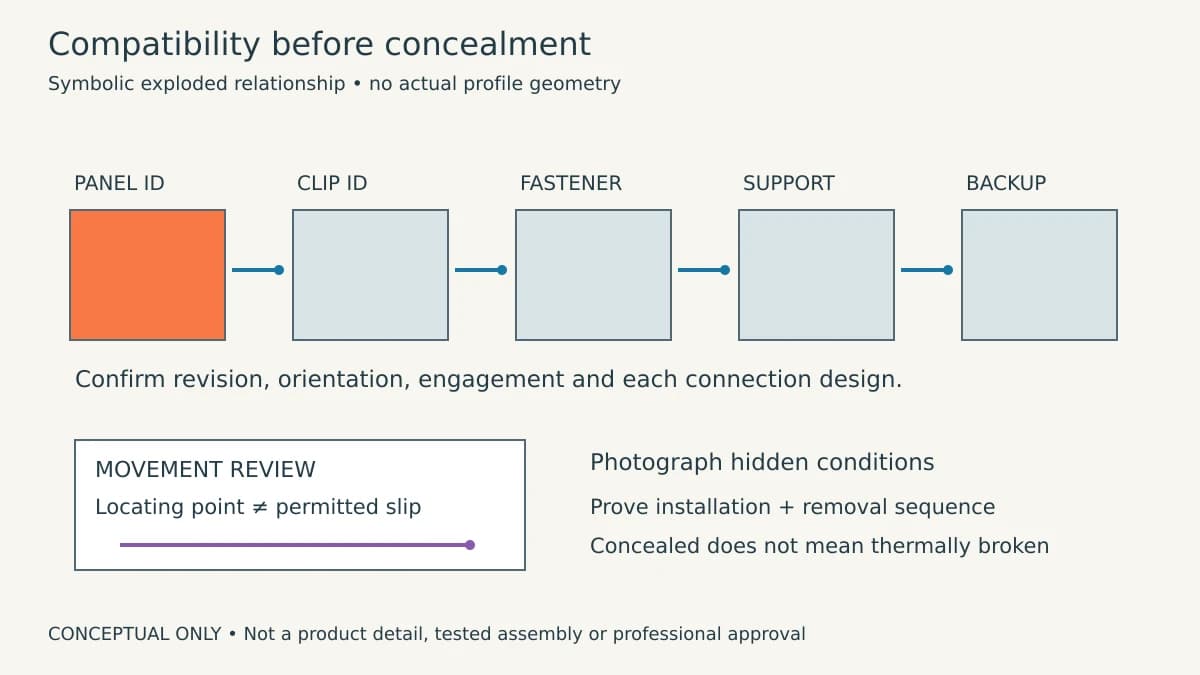
A Compatibility Checklist for the Selected Profile
Keep unverified fields marked pending. A sample that clicks together can help demonstrate assembly sequence, but it does not establish design load, durable engagement or approved tolerances. Record who provided each document and its date so substitutions can be checked against the same baseline.
| Interface | Evidence to obtain | Release condition |
|---|---|---|
| Panel to clip | Current paired profile/clip drawing and part revisions | Supplier confirms intended engagement |
| Clip to support | Approved fastener and support specification | Connection design accepted |
| Support to backup | Anchor schedule and verified substrate | Engineering and site checks complete |
| Ends and transitions | Movement, termination and access details | No unintended restraint or collision |
| Overhead use, if proposed | Orientation-specific approval and load criteria | Do not infer from wall use |
Corrosion, Thermal Bridging and Service Access
Check every metal interface and fastener for the actual exposure, including trapped moisture and dissimilar-metal contact. Isolation materials must be compatible with the connection and approved assembly; do not add an improvised pad that changes engagement or load transfer. Concealment is an appearance choice, not proof of a thermal break. A metal support crossing insulation may still conduct heat, and thermal performance depends on the complete support geometry and wall assembly.
Likewise, hidden fixings do not prove that a middle panel can be removed independently. Obtain the sequence for reaching fasteners, releasing the panel and reinstating adjacent trims and weather-control details. Record whether removal is destructive and whether replacement parts must be retained.
Fixed Points, Permitted Slip and End Conditions
Ask the selected-system designer to identify locating points, movement-permitting connections and end clearances on the actual detail. A slotted-looking hole or concealed engagement must not be assumed to slide. Fastener position, tightening method, finishes and tolerances may affect the intended behavior. Resolve adjacent materials, corners and building movement joints before the mockup, and avoid inventing a universal gap or fastening torque.
What to Photograph and Approve at the Mockup
Photograph the labeled panel and clip parts before assembly, support alignment, fastener type and location, barrier repairs around penetrations, achieved engagement, ends and movement provisions. Include a scale and location identifier without treating a photograph as a substitute for inspection. Demonstrate installation and the proposed removal sequence, then record deviations, responsible reviewers and approval conditions before production. A visually straight finish alone does not verify the concealed connection.
A concealed clip is a mechanical attachment that engages a panel at a hidden edge or profile rather than putting a fastener through its exposed face. That describes the visual and attachment concept, not the complete rainscreen wall design. To use it responsibly, identify the actual panel/clip pairing, supporting structure, load path, movement provision, control layers, and termination details before installation.
How a Hidden Attachment Works
The clip's engagement surface holds the compatible panel profile against its support. The clip fastener then transfers demand to a verified rail, furring member, or backup structure through the specified connection. Different profiles can use different engagement and restraint mechanisms; do not assume every panel has the same rear channel or that a clip alone resists every load. Panel faces may have no exposed fasteners, while other parts of the wall can still need sealants, flashings, and accessible joints. The UFGS metal wall panel guide specification illustrates the submittals and execution topics that project specifications may need to address.
Components to Identify on the Shop Drawings
Barcode's public cladding catalog lists starter, clip, outside corner cap, end cap, joint, and J-channel components. It does not by itself establish that each accessory fits every profile or project assembly. Confirm the selected current profile and compatible accessories through technical review.
- Selected panel profile and its matching clip or other approved attachment.
- Verified backup, rails or furring, anchors, and fasteners with a documented load path.
- Starter, corner, end-cap, joint, and J-channel accessories where compatible with the selected layout.
- Independent water and air control layers, drainage outlets, insulation, and transition flashings.
- Fixed and sliding locations, cut ends, joints, and access or replacement strategy if required.
Verify the Backup and Fastening Path
Do not specify generic sheathing as sufficient anchorage. Confirm structural backup, in-service condition, edge distances, required backing, fastener substrate, loads, and permitted deflection for the project; substrate readiness should be established before fastening clips. Coordinate each attachment that penetrates an air or water barrier with that layer's detailing and inspection requirements, including air-barrier continuity. If the proposed backup differs from the design assumption, pause and resolve the change.
Plan a Sequence, Not a Universal Recipe
The correct sequence is defined by the selected profile and approved project details, including orientation and interfaces. Establish installation quality-control hold points for the work that will be concealed. These checkpoints are coordination prompts, not a manufacturer's installation instruction:
- Accept the backup and the inspected air/water-control and opening-flashing work before covering it.
- Set control lines and verify rails, anchorage, insulation, and unobstructed drainage paths.
- Review a representative area with the actual starter, panel, clip, and termination details.
- Follow the approved profile-specific engagement and fastening sequence.
- Check panel alignment, joint treatment, and finish protection continuously; record hidden conditions before cover.
Movement Must Be Designed, Not Assumed
Temperature changes affect aluminum length, but clip engagement does not guarantee lateral slip or a specific movement allowance. Identify fixed points, permitted slip, panel length, cut-end clearance, fastener behavior, and adjacent constraints when designing for thermal movement in aluminum cladding. Exposed and concealed attachment can each be designed to accommodate movement when properly engineered; neither label guarantees success.
Do Not Promise Individual Panel Removal
Some concealed systems permit panel replacement only after adjacent courses or trim are removed; others may require special release tools or have no non-destructive single-panel procedure. If future access is a project requirement, obtain a written procedure for the selected profile and demonstrate it at a mockup. Do not locate service equipment behind cladding on an assumption of easy access.
Decision Table: What to Ask Before Approving Clips
The table separates a marketing description from information that can support a submittal review.
| Question | Risk if unanswered | Approval evidence |
|---|---|---|
| Which panel engages which clip? | Incompatible accessory or insecure engagement | Current selected-profile detail and sample |
| Where do loads go? | Anchors miss adequate backing or overload supports | Project-approved attachment design and substrate confirmation |
| Where does water go? | Blocked drainage or unsealed control-layer penetrations | Sections through base, opening, and attachment |
| Where can the panel move? | Binding at clips, corners, or ends | Fixed/sliding points and movement details |
| How is damage repaired? | Hidden access requirement or expensive tear-out | Demonstrated replacement procedure if access is specified |
Keep the Enclosure Boundary Clear
A hidden clip is an attachment choice, not a waterproofing system. The wall still needs a designed water-control layer, continuous air barrier, flashings, appropriate cavity drainage and ventilation, and interfaces at openings. A drained and ventilated rainscreen is not automatically pressure equalized. Check assembly-level requirements with the responsible architect and enclosure professional rather than treating panel marketing as a test report.
Move From Profile Selection to Technical Review
Bring the architect's wall sections, design loads, backup description, panel orientation, finish, and critical openings to the technical review. Barcode's public catalog and technical specifications differ on some profiles and dimensions; ask for current selected-profile data rather than using either publication as automatic installation approval. Physical samples help verify appearance, not structure, code compliance, or enclosure performance.
Frequently Asked Questions
Are concealed clips waterproof?
No. Clips attach cladding to its support; the wall's water-control layer, cavity, flashings, and transitions must manage water that reaches behind the panels.
What clip spacing should I use?
There is no universal clip spacing. The selected profile, design loads, backup, support configuration, orientation, and project-approved engineering determine attachment spacing.
Do concealed clips automatically allow thermal movement?
No. Movement behavior depends on the clip and panel geometry, fastener restraints, fixed points, lengths, and end conditions. Obtain the selected system's current movement details.
Can each panel be removed independently?
Not necessarily. Access depends on engagement geometry, the installation order, adjacent panels, and trims. If replacement or access matters, require a documented procedure and demonstrate it at a mockup.
Can the catalog serve as an installation approval?
No. Use it to identify candidate profiles and accessories, then confirm current selected-profile information and project-specific assembly details through technical and professional review.
Sources & Further Reading
- WBDG — Building Enclosure Design Principles and Strategies
- WBDG — Air Barriers
- UFGS 07 42 13 — Metal Wall Panels

About the author
Jay Zdun
Founder, Barcode Cladding
Jay Zdun is the founder of Barcode Cladding. He specializes in aluminum façade systems and helps architects, builders, and property owners evaluate profiles, finishes, and installation considerations for modern exterior projects.
Connect on LinkedIn