
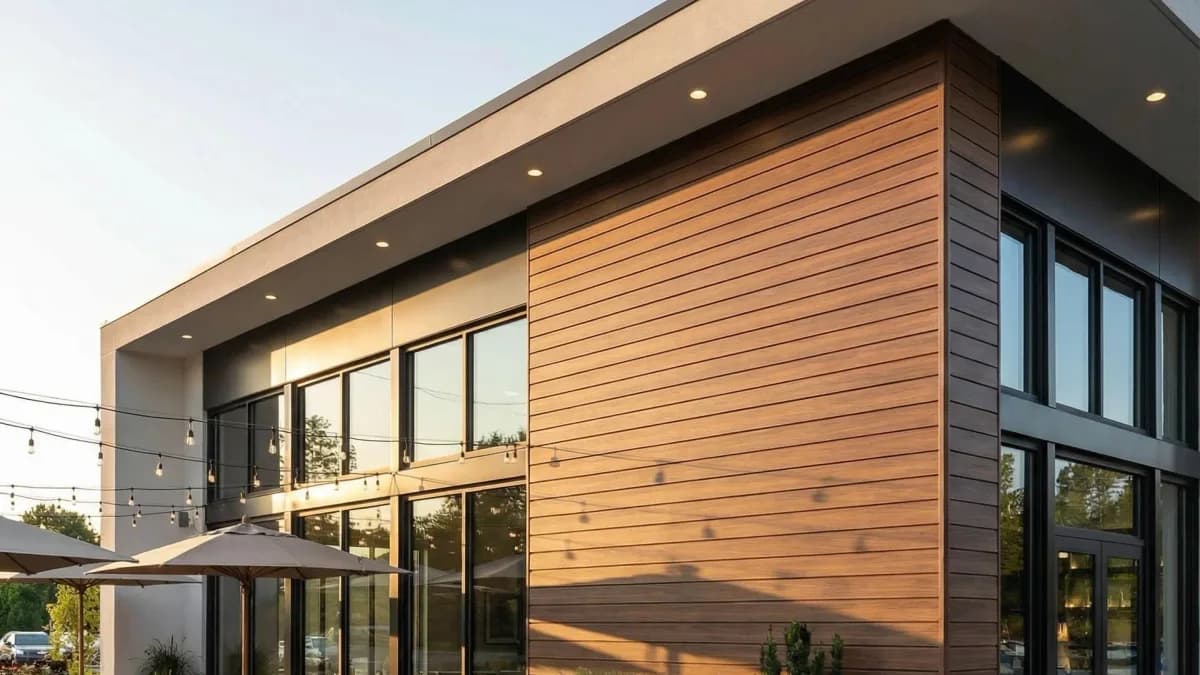
Aluminum and wood can both create durable, expressive exterior walls. This comparison explains how their weathering, maintenance, fire, detailing, and appearance considerations differ.
Key Takeaways
- Aluminum avoids biological decay and periodic staining, while wood offers authentic grain and can perform well when species, finish, detailing, and maintenance suit the exposure.
- Fire and code decisions belong to the complete exterior-wall assembly, not a material label alone.
- Installed cost, maintenance access, finish renewal, subframing, and replacement strategy should be compared for the actual project rather than with universal lifespan claims.
- Samples and project-specific mockups are the most reliable way to compare appearance, joint rhythm, and finish quality.
Aluminum and wood can both produce durable, expressive exterior walls, but they manage weathering, maintenance, and detailing differently. This comparison helps architects, builders, and owners decide which material better fits the project's exposure, design intent, maintenance plan, and wall-assembly requirements. The broader exterior aluminum cladding systems guide frames that choice alongside other assembly and material options.
Durability & Longevity
Aluminum does not rot or provide food for insects, but its finish, joints, fasteners, and supporting wall assembly still need correct specification and inspection. Wood can perform for a long time when the species, preservative treatment, coating, ventilation, flashing, and end-grain protection match the climate. Because service life depends on exposure and maintenance, compare project-specific warranties, finish data, repair access, and replacement strategy instead of relying on a single lifespan number.
| Decision factor | Aluminum cladding | Wood siding |
|---|---|---|
| Moisture response | Does not absorb water or decay, but joints and the backup wall must still drain | Can absorb moisture; species, coatings, ventilation, and end-grain details matter |
| Finish care | Cleaning and inspection; repair damaged coatings according to the finish supplier | Cleaning plus periodic coating inspection and renewal where a finish system requires it |
| Appearance over time | Designed for relatively consistent color and module geometry | Natural variation and weathering may be part of the design intent |
| Repair planning | Confirm panel removal, replacement stock, and color-match strategy | Confirm board access, matching species/profile, and localized refinishing |
Maintenance Requirements
Factory-finished aluminum generally avoids the recurring staining or painting associated with many exterior wood finishes, but it is not maintenance-free. Both systems benefit from scheduled inspection of joints, penetrations, flashings, damage, and areas that do not receive natural rain washing. Wood maintenance varies significantly by species, orientation, coating type, and the amount of weathering the design accepts.
- Aluminum: inspect transitions and damage; clean with methods approved by the finish supplier
- Wood: inspect moisture-sensitive details and renew coatings when their condition requires it
- For either material: keep drainage paths open and repair flashing or sealant failures at adjacent assemblies
Fire Performance
Solid aluminum is noncombustible as a material, while wood is combustible. That distinction matters, but it does not establish compliance for an exterior wall by itself. Insulation, membranes, attachments, cavities, coatings, substrates, building height, construction type, and tested assembly details can all affect the required code path, including whether NFPA 285 exterior-wall testing applies. The design team should review the complete wall assembly, applicable code provisions, test reports where required, and authority-having-jurisdiction expectations.
Aesthetic Versatility
Modern aluminum cladding is not the industrial corrugated sheet of the past. Barcode Cladding panels are available in wood-look sublimation finishes that are genuinely difficult to distinguish from real wood at conversational distance, as well as anodized and powder-coated options in virtually any color. The wood-look sublimation finish process also matters when assessing repeat and exterior suitability. The profiles — 4", 6", and 8" widths — create clean shadow lines that are architecturally expressive without the biological unpredictability of real wood. Physical finish samples help compare the options in project lighting.
Installation Speed
Installation speed depends on panel dimensions, wall geometry, subframing, openings, corners, access, crew familiarity, and tolerance correction. A repeatable concealed clip-and-panel layout can simplify alignment across large areas, while wood may be familiar to more residential crews and easier to modify with common carpentry tools. Request installer input and price the actual elevations rather than assuming one material is always faster.
Weight
Do not compare weight from the face material alone. Panel geometry, clips, rails, furring, sheathing, insulation, and attachment requirements all contribute to the installed dead load. Use manufacturer data and the structural engineer's project-specific review when substrate capacity or upper-floor installation is a concern.
When Wood Still Makes Sense
Wood is a strong candidate when authentic material character, local craft, renewable-material goals, or intentional natural weathering are central to the design. It also works well when the owner accepts the inspection and finish-care plan. Aluminum is often a better fit when dimensional consistency, noncombustible face material, repeatable modules, and reduced finish-renewal work are higher priorities.
Bottom Line
Choose aluminum or wood by matching the complete wall system to the project's design intent, exposure, code path, construction team, maintenance capacity, and budget. For another wood-derived alternative, wood-composite cladding brings its own material and maintenance tradeoffs. Aluminum can reduce finish-renewal demands and eliminate biological decay at the cladding face; wood provides authentic grain and natural variation. Neither choice removes the need for drainage, ventilation where required, compatible attachments, and carefully detailed transitions.
Request samples to compare real wood with wood-look and solid-color aluminum in the project's lighting and at the intended viewing distance.
Frequently Asked Questions
Does aluminum cladding last longer than wood siding?
There is no universal service-life number for either material. Aluminum avoids rot and insect damage, while wood performance depends strongly on species, treatment, coatings, ventilation, exposure, and maintenance. Compare the actual products, finish warranties, wall details, maintenance plan, and repair strategy for the project.
Is aluminum cladding maintenance-free?
No exterior cladding is maintenance-free. Aluminum usually avoids periodic staining or painting, but it still needs inspection and appropriate cleaning, and damaged coatings or adjacent flashing failures need attention.
Is aluminum always the safer fire-code choice?
Solid aluminum is noncombustible as a material, but code compliance is determined for the complete exterior-wall assembly and project conditions. Insulation, membranes, cavities, attachments, building height, construction type, and required testing must all be reviewed.
Which costs less: aluminum cladding or wood siding?
The answer depends on product grade, geometry, subframing, labor, access, finishes, maintenance, and replacement planning. Compare installed bids and an agreed lifecycle period using project-specific assumptions rather than a generic percentage.
Sources & Further Reading
- USDA Forest Products Laboratory — Wood Handbook
- Whole Building Design Guide — Wall Systems
- NFPA — NFPA 285 Standard Development
- The Aluminum Association — Building & Construction

About the author
Jay Zdun
Founder, Barcode Cladding
Jay Zdun is the founder of Barcode Cladding. He specializes in aluminum façade systems and helps architects, builders, and property owners evaluate profiles, finishes, and installation considerations for modern exterior projects.
Connect on LinkedIn