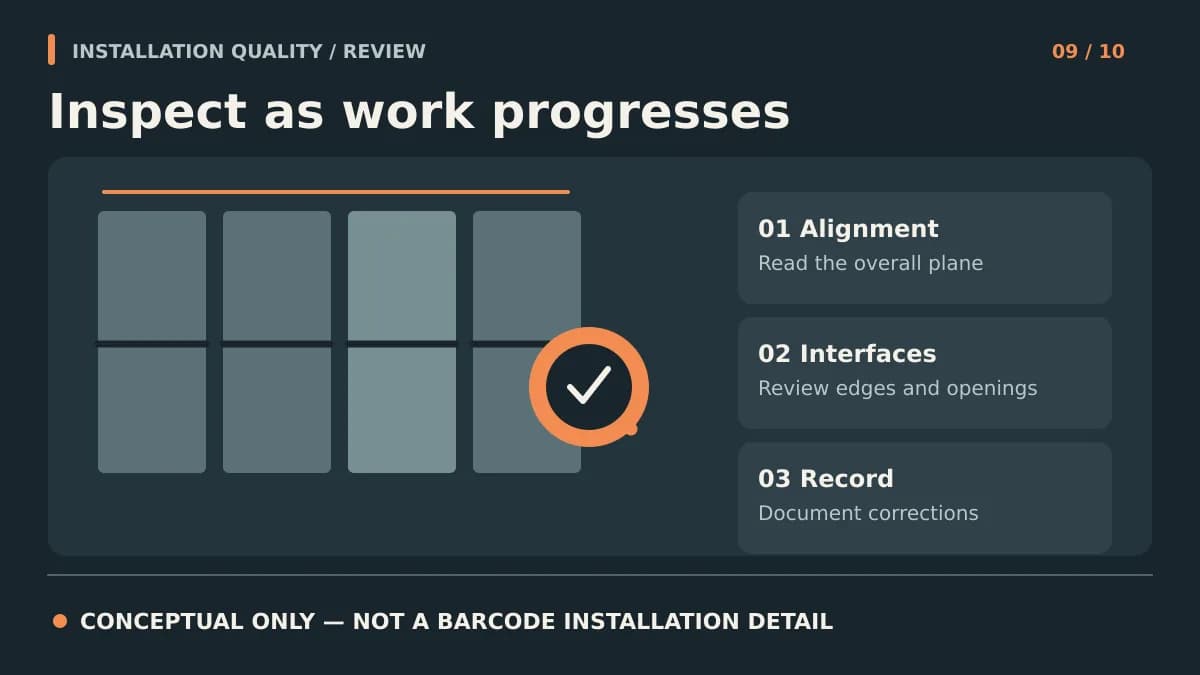
Do not leave quality checks until the last panel is installed. A few clearly assigned hold points let the team correct hidden interfaces and visible alignment while they remain accessible.
Key Takeaways
- Agree who inspects each condition and what approval is needed before it is covered.
- Use a first-bay review to test the approved layout and interface details, not as a substitute for engineering or enclosure approval.
- Separate hidden-layer evidence from visible finish acceptance and record both.
- Log defects with locations, responsible parties, correction evidence, and reinspection status.
An installation-quality plan is a sequence of decisions within the complete aluminum rainscreen installation, not a final walk-through. Define the hold points before delivery: what gets checked, against which approved drawings or product information, by whom, and how a failure is resolved. These checks help prevent repeat defects but cannot establish code compliance or test performance on their own.
Set the Baseline Before the First Panel
Review approved wall sections, selected Barcode profile and accessory information, shop drawings, assembly responsibilities, and any project mockup criteria. Make sure trades share the same datum and that substrate readiness has been confirmed. Confirm current profile information with Barcode in technical review: catalog and technical page information may not align, and the catalog is not an installation approval. Inspect materials on delivery for damage, finish mismatch, or wrong profile before they are distributed into the work area.
- Identify the approved document revision governing each elevation and interface.
- Name the reviewer for backup, barriers, supports, panels, and finish.
- Define the viewing conditions for appearance review without implying an unprovided numeric tolerance.
- Keep unresolved design changes out of the production-installation area.
Inspect in Stages While Corrections Are Still Possible
The NIBS enclosure-commissioning guideline calls for planned inspection protocols and review of interface conditions. Translate that principle into specific project checkpoints. A first-bay review checks whether approved module lines, supports, clips, and terminations actually work together; it does not replace attachment engineering, air/water-control acceptance, or any required project testing.
| Hold point | What to verify | Evidence |
|---|---|---|
| Pre-cover wall | Backup, control layers, flashing, anchors and drainage exit | Marked location, photos, release record |
| First supports / bay | Datum, support engagement, panel sequence, movement intent | Approved first-bay notes and corrections |
| Before closing an interface | Penetrations, corners, openings, barriers and access | Detail reference and concealed-work photos |
| Progressive finish review | Alignment, finish, edge treatment, damage | Issue list with corrected / rechecked status |
| Handover | Open-item closeout, spare material, approved care instructions | Record set and owner information |
Review Appearance Without Ignoring Performance Interfaces
Judge the finish in agreed lighting and viewing conditions against the architectural cladding mockup, but check hidden work in its own inspection step. Examine joints for consistent intended rhythm, terminations for fit, panels for visible damage, and edges for intentional treatment. Also verify that approved movement positions were not pinned shut, cavity drainage was not blocked, and the barrier was not damaged by a later trade. If the joint looks good yet the concealed detail differs from the approved design, escalate rather than signing off based on appearance.
Close the Loop With Product and Project Records
Barcode's panels, starter and clip accessories, joint and edge accessories, and wood-look, anodized, or powder-coat finish families are selection inputs. Compare physical samples for the chosen appearance; request technical review to verify the current profile and compatible details. The project team must set installation acceptance criteria, assembly requirements, and inspection responsibilities. At handover, retain approved details, inspection photos, corrections, selected-profile records, and owner care instructions rather than claiming that visual signoff proves tested wall performance.
Frequently Asked Questions
Is a finished-wall walk-through enough quality control?
No. Hidden backing, barrier integration, anchorage, and drainage need inspection while still accessible, with a later check of visible work and closeout records.
Does an approved first bay certify the whole wall?
No. It confirms a representative condition against the approved project documents and establishes a process; atypical interfaces and later changes still require review.
What if the delivered panel finish differs from the sample?
Hold distribution of the affected material, identify the selected finish and approved reference, document conditions consistently, and resolve the discrepancy with the supplier and project team before widespread installation.
Can Barcode approve the complete rainscreen assembly?
Product technical review can address selected Barcode profiles and accessories. The responsible project professionals approve the complete substrate, control layers, attachment, code path, testing, and inspection requirements.
Sources & Further Reading
- NIBS — Building Enclosure Commissioning Process, Guideline 3-2012
- GSA — 2024 P100 Building Enclosure Training
- Barcode Cladding — 2026 Catalog (confirm current selected profile)

About the author
Jay Zdun
Founder, Barcode Cladding
Jay Zdun is the founder of Barcode Cladding. He specializes in aluminum façade systems and helps architects, builders, and property owners evaluate profiles, finishes, and installation considerations for modern exterior projects.
Connect on LinkedIn