
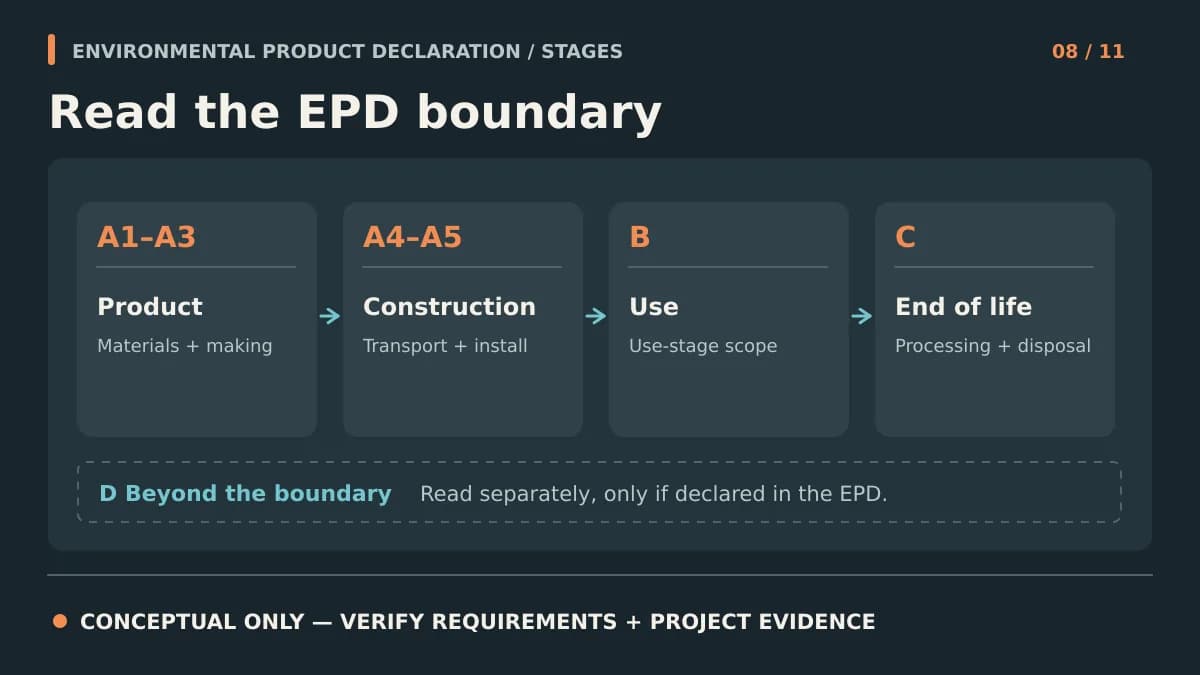
Aluminum's recyclability is not a project carbon number. Compare documented products using the same functional basis, EPD rules, and lifecycle boundaries.
Key Takeaways
- An industry-average aluminum EPD is not automatically a product-specific declaration for the selected cladding panel.
- Compare declared or functional units, PCR, geographic and time scope, lifecycle stages, and included finishes or subframes.
- Recyclability and recycled content are different measures; neither by itself establishes low embodied carbon.
- Request current, applicable, verified documentation before making Barcode-specific environmental claims.
Sustainability discussions about aluminum often begin and end with “recyclable.” That is only one part of a project's environmental accounting and the wider cladding performance, codes, and lifecycle review. Primary production, recycled feedstock, extrusion or forming, finishing, transport, maintenance, replacement, and end-of-life routes can all affect results. An environmental product declaration (EPD) reports quantified impacts for a defined product and scope using life-cycle assessment rules; it does not by itself declare that a product is sustainable or compatible with every project. The EPA's EPD Basics guide explains the roles of product category rules (PCRs), third-party verification, and the data behind a declaration.
Identify the Declaration You Actually Have
An industry-average EPD describes a category or participating producers, not necessarily a specified profile and finish. A product-specific declaration may still cover a family with configuration limits. Read the named manufacturer, program operator, validity period, product description, plant or geographic basis, and verification statement. Check whether the particular coating, profile, and production route are included. The Aluminum Association's EPD resources provide industry materials, but an association document should not be relabeled as a Barcode-specific panel EPD. If no applicable declaration is available, say so and ask the project sustainability lead which alternative evidence is acceptable.
Make the Comparison Boundary Visible
EPD values are not safely comparable because two PDFs both print a global-warming-potential number. First align the PCR, declared unit, lifecycle modules, reference service life where relevant, and included accessories. ISO 21930 provides core rules for construction-product EPDs; the EPA notes additional PCR-specific comparability conditions. A cradle-to-gate result does not contain the same stages as a cradle-to-grave study. A kilogram of metal is not automatically equivalent to a square meter of installed façade: material quantity, coverage, support, and replacements differ. Have the LCA practitioner normalize quantities and function before drawing conclusions.
| Comparison check | Why it matters | Action |
|---|---|---|
| Declared unit and coverage | Mass and installed area are not interchangeable | Convert using documented project quantities |
| PCR and verification | Method and assurance may differ | Confirm valid rules and third-party verification |
| Modules and boundaries | Transport, use, and end of life may be omitted | Compare like-for-like stages or disclose differences |
| Panel plus assembly | Subframe and replacements add impacts | Set a consistent installed-wall scope |
Distinguish Recycled Content From Future Recovery
Recycled content concerns inputs to the product; recyclability concerns a possible future route. Neither guarantees that panels on a particular job will be recovered or that processing will have zero impacts. Ask whether the declaration's input data reflects the actual supply chain and whether scrap, demolition separation, fasteners, coatings, and transport are treated consistently. Avoid double counting benefits from recycling across compared products. If a proposed design allows easier disassembly, document that as a design intent and specify the collection path; do not present future recovery as a measured outcome before it occurs.
Consider Durability and Use-Stage Tradeoffs
An option with a low initial embodied impact may require more frequent renewal; one with a higher initial impact may still need a costly or carbon-intensive support system. Compare on the same study period with explicit maintenance, replacement, and finish assumptions, and distinguish modeled scenarios from tested product claims. Include relevant energy effects only if the whole wall and building model support them. Color samples help choose the desired visual result, not an EPD boundary or measured carbon intensity. A sustainability evaluation should sit alongside lifecycle-cost planning, not confuse dollars with carbon or replace enclosure design.
Build a Project Evidence Request
Request the selected-profile identity, applicable EPD and PCR, verification and validity dates, covered finishes, declared unit, modules, relevant input data, and assumptions about replacement and end of life. The solid aluminum versus composite distinction changes bill-of-material assumptions; service-life and warranty planning informs renewal assumptions in the study period. Ask the sustainability lead to document unavailable data and the method used for comparison. On a project with a procurement carbon target, clarify who approves substitute products and whether the target applies at product, assembly, or building level. Preserve the declaration version actually used in the analysis; a later edition may change methods or input data. Show uncertainty openly when quantities, sourcing, or service-life scenarios remain unresolved. Do not assert a Barcode recycled-content percentage, carbon footprint, LEED contribution, or EPD availability without current supporting documents for the selected product. Product and finish selection can proceed while those requests are resolved, but environmental marketing copy should wait for evidence.
Frequently Asked Questions
Does the Aluminum Association EPD cover every Barcode panel?
No. An industry-average declaration cannot be treated as a product-specific Barcode EPD. Check named products, scope, validity, and program rules before citing it for a selected panel.
Is recyclable aluminum automatically low-carbon?
No. Production route, recycled inputs, finishing, quantity, transport, and end-of-life assumptions all matter. Recyclability alone does not quantify a project's embodied emissions.
Can I compare the GWP numbers on two EPD cover pages?
Not safely without checking equivalent units, PCR comparability rules, scope, lifecycle stages, and product function. An LCA practitioner should normalize project quantities.
Does an appearance sample prove environmental attributes?
No. A physical sample supports visual review only; environmental claims require applicable documented evidence such as a verified, in-scope EPD.
Sources & Further Reading
- US EPA — EPD Basics: A Manufacturer's Guide to How and Why to Develop an Environmental Product Declaration
- ISO — ISO 21930:2017 Core Rules for Construction Product EPDs
- The Aluminum Association — Environmental Product Declarations

About the author
Jay Zdun
Founder, Barcode Cladding
Jay Zdun is the founder of Barcode Cladding. He specializes in aluminum façade systems and helps architects, builders, and property owners evaluate profiles, finishes, and installation considerations for modern exterior projects.
Connect on LinkedIn