
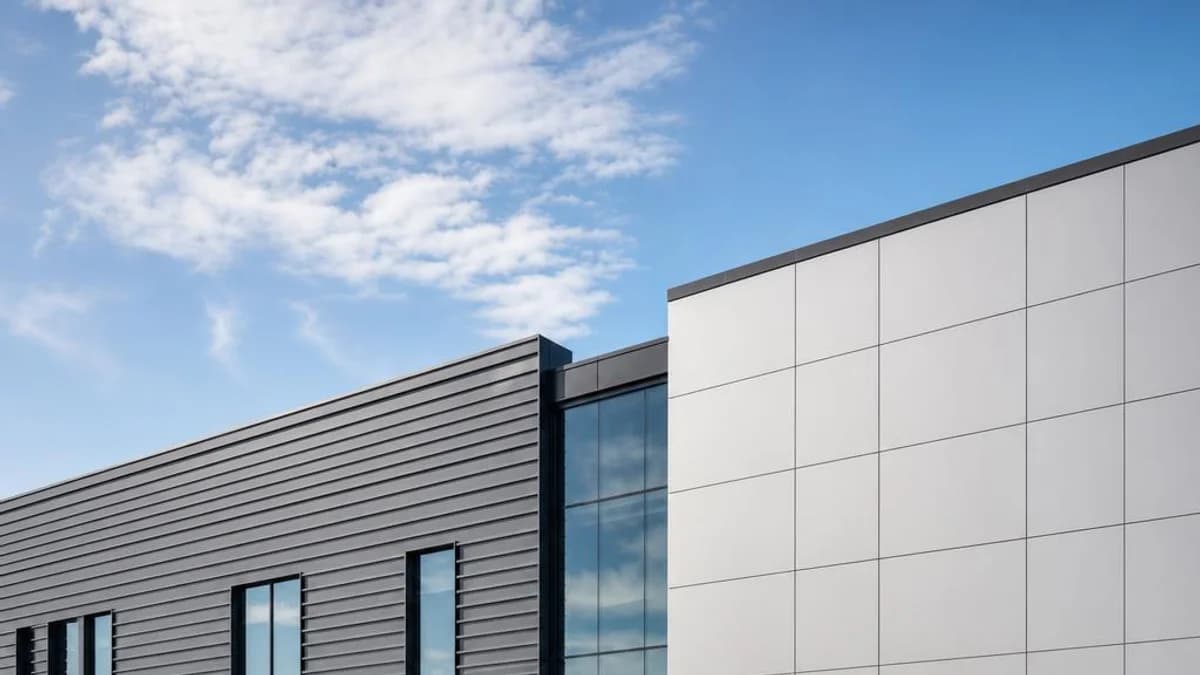
Solid aluminum and aluminum or metal composite material can both create precise metal façades, but they are not interchangeable. The right choice depends on panel construction, geometry, tested wall assembly, detailing, fabrication, and design intent.
Key Takeaways
- Solid or extruded aluminum is one metal throughout; ACM/MCM is a factory-made sandwich panel with metal skins bonded to a core.
- ACM/MCM is often well suited to broad, flat cassette surfaces, while extrusions can integrate profiles, reveals, attachment features, and linear expression.
- Fire compliance belongs to the complete wall assembly and project conditions—not to a material nickname or a metal face sheet alone.
- Compare approved details, tested assemblies, finish systems, module sizes, fabrication access, and installer capability before comparing bids.
The Short Answer
Choose solid or extruded aluminum when a monolithic metal section, linear profile, crisp shadow line, or integrated attachment geometry drives the design. Consider ACM/MCM when large, flat, fabricated cassettes and efficient coverage are priorities. Either can be appropriate, but the specification must identify the actual product, core, attachment, finish, and wall assembly. That assembly-level choice sits within the broader exterior aluminum cladding system selection.
What Solid Aluminum and ACM/MCM Mean
Solid sheet and extruded profiles consist of aluminum through their full thickness. Extrusion pushes heated aluminum through a die, allowing a repeatable cross-section with returns, grooves, or attachment features. Aluminum composite material (ACM) is a type of metal composite material (MCM): thin metal skins are bonded to a core. Core composition varies, so “ACM” alone is not a complete fire or performance specification.
Side-by-Side Decision Table
Use this table to identify the questions that should move into design development and submittal review; it is not a substitute for project-specific engineering.
| Decision factor | Solid/extruded aluminum | ACM/MCM |
|---|---|---|
| Construction | Monolithic aluminum sheet or shaped section | Bonded metal skins and a specified core |
| Typical visual strength | Linear profiles, depth, reveals, and shaped sections | Broad, flat cassettes and folded-panel geometry |
| Fabrication | Cutting, machining, forming, or profile-specific operations | Routing, folding, and cassette fabrication |
| Fire review | Review coatings, attachments, insulation, barriers, and assembly | Also verify core designation and applicable assembly testing |
| Repair planning | Depends on profile access, finish, and attachment | Depends on cassette layout, attachment, and color matching |
| Specification priority | Alloy, temper, thickness, profile, finish, and attachment | Skin, core, total thickness, finish, fabrication, and attachment |
Form, Module, and Appearance
ACM/MCM can deliver large planar fields with routed-and-returned edges, making it useful for folded cassettes, canopies, and geometric transitions. Extruded aluminum is useful when the repeated section itself creates depth, rhythm, ventilation openings, or concealed engagement. Both can receive architectural finishes, but gloss, metallic effect, grain direction, batch variation, and viewing angle should be reviewed with physical samples and elevation-specific mockups.
Fire and Code Review
A metal exterior face does not establish the fire performance of an exterior wall. The design team should identify occupancy, construction type, building height, separation distance, insulation, air and water layers, attachments, cavity conditions, and applicable code provisions. For MCM, confirm the exact core and evidence that corresponds to the proposed assembly. Substitutions should be checked against the basis-of-design assembly rather than accepted by a generic “metal panel” description.
Water, Movement, and Detailing
Both choices need a coherent water-management strategy behind the face. Define drainage, ventilation where required, joint geometry, flashing, penetrations, perimeter transitions, and interfaces with windows and roofing. Aluminum moves with temperature; thermal movement in cladding means module length, joint width, clips, and fastener slots must accommodate expected movement without assuming the cladding is the primary water barrier.
Procurement and Installation Questions
- Who owns shop drawings, structural calculations, panel optimization, and field dimensions?
- Can the local fabricator and installer demonstrate experience with the specified system?
- How are damaged units removed without disturbing adjacent work?
- Are finish samples representative of production direction, sheen, and lot variation?
- Does an alternate preserve the specified core, attachment, joints, tested assembly, and visual module?
Best-Fit Recommendations
Solid or extruded aluminum is a strong candidate for linear façades, soffits, screens, and projects where the profile produces the architectural expression; actual extruded aluminum cladding profiles can help define the linear option. ACM/MCM is a strong candidate for large cassette modules, folded shapes, and expansive smooth surfaces. Mixed façades can use both effectively. Make the decision with a wall-section review, representative corner or transition detail, finish sample, and—when risk or visual complexity warrants it—a project mockup. When both candidates are monolithic metals instead, aluminum versus steel cladding involves a different set of stiffness and corrosion tradeoffs.
Frequently Asked Questions
Is ACM the same as solid aluminum?
No. ACM has aluminum face sheets bonded to a core; solid aluminum is aluminum through its thickness. Their fabrication methods, edge details, specification requirements, and fire-review paths differ.
Is all MCM the same?
No. Metal skins, core composition, thickness, finish, attachment, and tested assemblies vary. Specify and review the exact proposed product rather than relying on the MCM label.
Which material is better for curved or dimensional façades?
It depends on radius, module, repetition, finish, and fabrication. Extrusions suit repeatable shaped cross-sections; MCM can suit routed, folded, or fabricated forms. Early fabricator input is valuable.
Can a material alone prove code compliance?
No. Compliance depends on the complete assembly and project conditions. The architect, engineer, code consultant, manufacturer, and authority having jurisdiction should review applicable evidence.
Sources & Further Reading

About the author
Jay Zdun
Founder, Barcode Cladding
Jay Zdun is the founder of Barcode Cladding. He specializes in aluminum façade systems and helps architects, builders, and property owners evaluate profiles, finishes, and installation considerations for modern exterior projects.
Connect on LinkedIn