
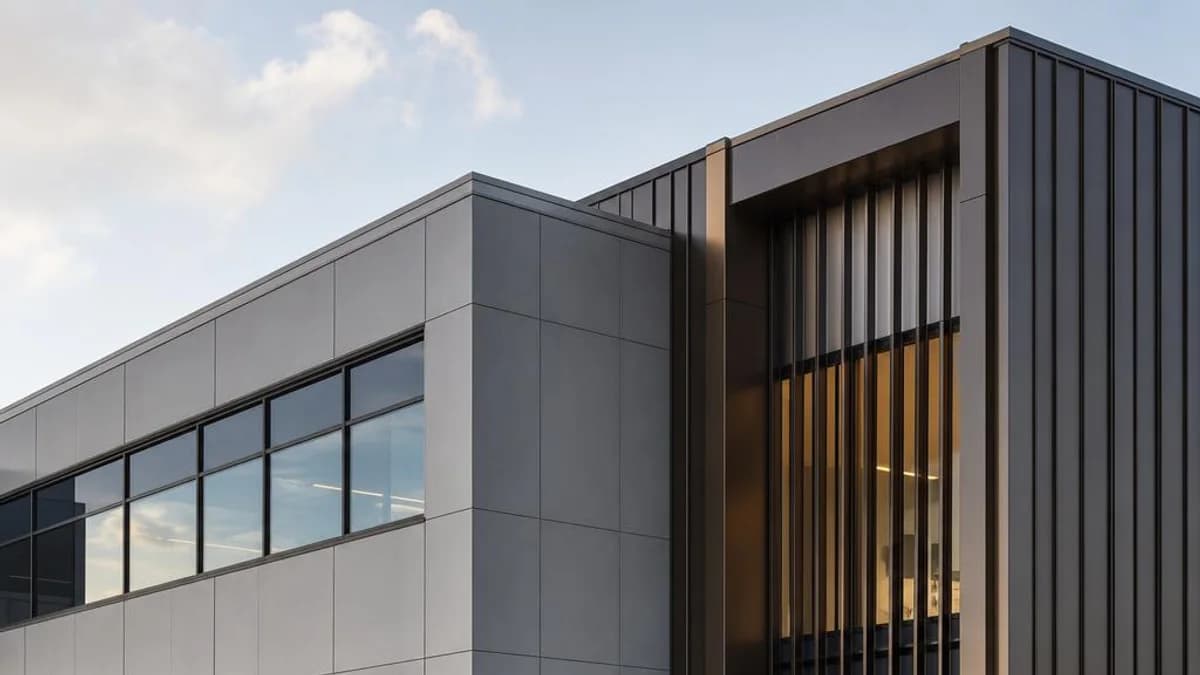
Aluminum and steel are both capable architectural cladding metals. Aluminum is lighter and forms a protective oxide layer; steel offers high stiffness and a distinct material expression, but its grade, coating, edges, and exposure demand deliberate corrosion detailing.
Key Takeaways
- Both metals can support durable, precise façades when the alloy or grade, finish, joints, attachments, and exposure are correctly specified.
- Aluminum's lower density can simplify handling; steel's higher stiffness can benefit some spans and profiles. Gauge alone is not a valid cross-material comparison.
- Corrosion strategy differs: aluminum needs compatible contacts and finishes, while carbon steel relies heavily on coating continuity and edge protection.
- Choose by geometry, structural criteria, local environment, finish intent, installer capability, and lifecycle maintenance—not by material name alone.
The Short Answer
Aluminum often fits lightweight, corrosion-conscious, highly finished façades and complex extruded profiles, whose formats vary across exterior aluminum cladding systems. Coated carbon steel can fit stiff formed panels and economical industrial or architectural modules; stainless and weathering steels answer different aesthetic and exposure goals. None is universally superior. Define the exact metal and coating before evaluating the option.
Material Families Matter
“Aluminum” includes different alloys and tempers, while “steel” may mean galvanized or coated carbon steel, stainless steel, or weathering steel. Those distinctions influence forming, fastening, finish compatibility, staining risk, and exposure suitability. Contract documents should state substrate, thickness, coating or finish, and relevant standards rather than using a broad metal label.
Aluminum and Steel Decision Table
This table frames early selection. Final panel sizing and attachment must follow system-specific engineering.
| Criterion | Architectural aluminum | Architectural steel |
|---|---|---|
| Weight and handling | Lower density; useful where handling or dead load matters | Higher density; panel stiffness depends on grade, thickness, and geometry |
| Shape options | Sheet forming plus complex constant-section extrusions | Well suited to roll forming and brake-formed profiles |
| Corrosion approach | Protective oxide plus specified finish; isolate incompatible contacts | Match steel type and coating to exposure; protect cuts, edges, and damage |
| Finish character | Anodized, painted, or powder-coated options | Metallic coatings, paint systems, stainless, or weathering surfaces |
| Thermal movement | Relatively high expansion requires planned joints and attachments | Still requires movement planning; coefficient differs from aluminum |
| Best-fit signal | Lightweight profiles and controlled architectural finishes | Stiff formed skins or a specifically desired steel expression |
Corrosion and Material Compatibility
Exposure drives the corrosion plan. Coastal cladding conditions, deicing salts, industrial pollutants, sheltered wet areas, and runoff from other materials deserve special review. Separate dissimilar metals where galvanic action is possible, use compatible fasteners, prevent persistent moisture traps, and follow coating instructions for field cuts and repairs. Weathering steel also needs suitable wet-dry cycling and careful runoff detailing; it is not appropriate merely because a rust-colored surface is desired.
Finish, Color, and Visual Aging
Painted aluminum and steel can begin with a similar color yet weather differently because substrate preparation, coating chemistry, forming, orientation, and exposure differ. Anodized aluminum, stainless steel, metallic-coated steel, and weathering steel each have distinct variation and reflectivity. Approve full-size samples, establish grain or coating direction, and locate mockups in representative light.
Structure, Movement, and Details
Do not translate an aluminum gauge directly into a steel gauge. Wind pressure, support spacing, profile depth, perforation, openings, fastener pull-through, deflection criteria, and oil-canning expectations all matter. Coordinate thermal movement with corners and openings, and preserve the continuity of air, water, and thermal control layers behind either rainscreen.
Installation and Lifecycle Planning
- Confirm lifting, cutting, swarf removal, and touch-up procedures for the selected metal.
- Specify compatible clips, fasteners, membranes, sealants, and flashings.
- Make accessible replacement zones around high-risk impact areas.
- Document cleaning methods that will not damage the finish.
- Evaluate environmental product declarations and recycled-content data from the actual supplier, not generic assumptions.
Best-Fit Recommendations
Favor aluminum when low weight, extrusion geometry, anodized appearance, or a broad architectural finish palette leads the brief; architectural aluminum panel profiles provide examples of the linear option. Favor an appropriate steel when formed-panel stiffness, a stainless or weathering surface, impact conditions, or the project's structural and fabrication ecosystem supports it. For composite-panel construction rather than monolithic metal, solid aluminum versus ACM/MCM is a different decision.
Frequently Asked Questions
Does steel cladding always rust?
No. Steel type, metallic coating, paint system, detailing, exposure, and maintenance determine corrosion behavior. Carbon, stainless, and weathering steels should not be treated as one material.
Is aluminum weaker than steel for cladding?
A simple material-strength comparison is misleading. Panel capacity depends on alloy or grade, thickness, profile geometry, span, supports, fasteners, and design loads. A qualified professional should size the system.
Can aluminum and steel touch in a wall assembly?
Dissimilar-metal contact may require isolation, especially when moisture creates an electrolyte. Confirm compatible fasteners, separators, coatings, and details with the project team and manufacturers.
Which metal is more sustainable?
That cannot be answered generically. Compare product-specific environmental declarations, recycled content, manufacturing location, finish, quantity, service conditions, maintenance, replacement, and realistic recovery pathways.
Sources & Further Reading

About the author
Jay Zdun
Founder, Barcode Cladding
Jay Zdun is the founder of Barcode Cladding. He specializes in aluminum façade systems and helps architects, builders, and property owners evaluate profiles, finishes, and installation considerations for modern exterior projects.
Connect on LinkedIn