
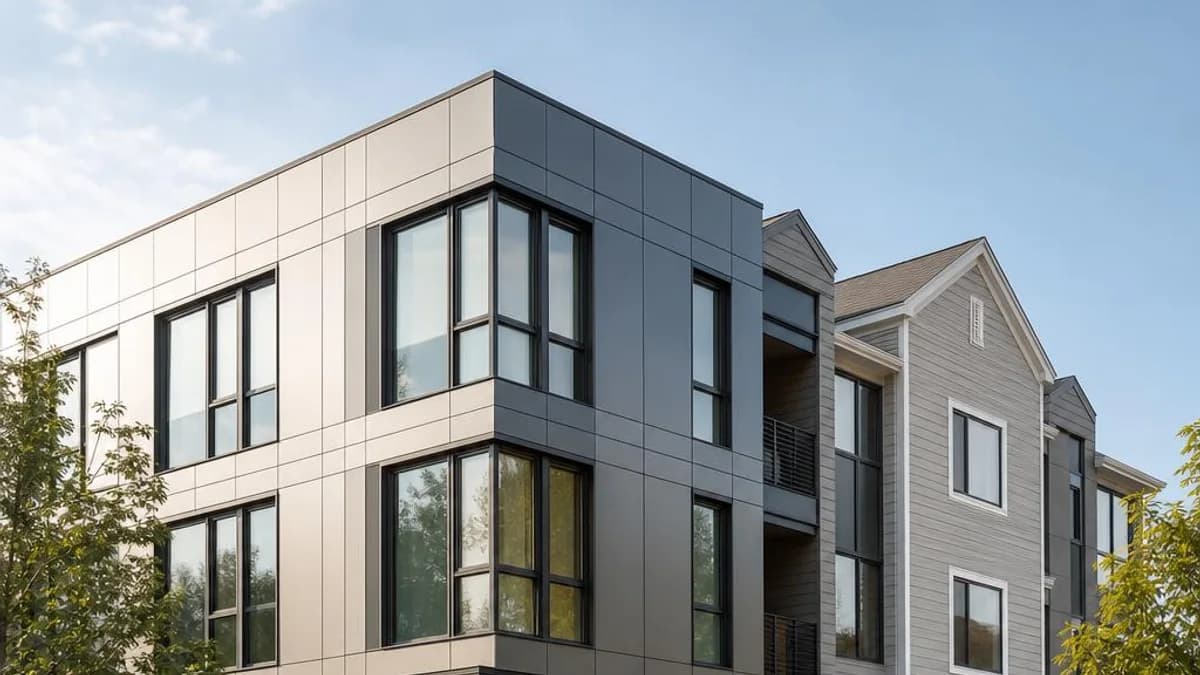
Architectural aluminum cladding and vinyl siding can both cover exterior walls, but that is where much of the similarity ends. One is commonly selected as a designed commercial façade system; the other is commonly optimized for familiar residential siding patterns and installation economics.
Key Takeaways
- This is usually a project-role decision, not a like-for-like panel comparison.
- Architectural aluminum supports intentional façade modules, reveals, metal finishes, and commercial detailing; vinyl commonly supports residential-scale lap or board-and-batten patterns.
- Both require drainage, flashing, expansion accommodation, correct fastening, and manufacturer-approved accessories.
- For multifamily or mixed-use work, evaluate code, wind, fire, substrate, height, transitions, and replacement areas for the exact assembly.
The Short Answer
Use architectural aluminum when the façade is a prominent design element with controlled profiles, shadow lines, finish selection, and detailed commercial transitions; exterior aluminum cladding systems include several different formats for this role. Vinyl siding can be appropriate for low-rise residential work where familiar patterns, widespread trade availability, and initial economy align with the brief. Do not assume the two scopes include the same subframing, accessories, engineering, or visual outcome.
Commercial Cladding and Residential Siding Are Different Briefs
Architectural aluminum is often scheduled by profile, alloy, finish, joint, orientation, attachment, and transition details. Commodity vinyl siding is typically selected from standardized residential profiles with coordinated trim accessories. Premium or specialty vinyl products exist, and simple aluminum siding exists too; this comparison is specifically between design-led commercial aluminum and mainstream residential vinyl.
Decision Table by Project Intent
Use this table to decide whether both materials genuinely belong on the same shortlist.
| Question | Architectural aluminum cladding | Commodity vinyl siding |
|---|---|---|
| Typical intent | Designed commercial, civic, institutional, or multifamily façade | Familiar low-rise residential exterior skin |
| Visual module | Customizable linear profiles, reveals, orientation, and finish | Standard lap, shake, or board-and-batten patterns |
| Support and attachment | System-specific clips, rails, or furring as designed | Nailing flange and accessories over an approved substrate |
| Movement | Engineered joints and attachment provisions | Loose fastening and clearances per installation instructions |
| Impact and repair | Profile-specific replacement and finish matching | Individual courses or areas may be replaced; matching aged color matters |
| Specification depth | Metal, finish, geometry, loads, assembly, and transitions | Profile, color, thickness/class, accessories, and installation standard |
Appearance, Scale, and Transitions
Aluminum can create deep linear relief, crisp openings, varied orientation, and anodized, powder-coated, painted, or decorative finishes. Vinyl typically expresses overlapping courses or molded patterns with proprietary corners and trims. Compare actual corner widths, window returns, base details, soffits, penetrations, and termination pieces—not just small color chips.
Heat, Movement, and Installation
Both materials move as temperature changes, though their properties and fastening methods differ. Vinyl installation depends on prescribed fastening freedom and clearances so panels can move without distortion. Aluminum cladding's thermal movement is addressed through designed joints, clips, fastener slots, and module limits. Dark colors, reflected heat, façade orientation, and nearby glazing should be reviewed against each manufacturer's limitations.
Water Management and Fire Review
Neither cladding should be assumed to stop all rain by itself. Coordinate flashings and the water-resistive barrier at every interruption. Fire review must consider the complete assembly and building conditions. Metal's noncombustible substrate does not make every aluminum wall assembly universally compliant, and vinyl products must be evaluated under their applicable code provisions and installation limitations.
Budget and Lifecycle Scope
Vinyl can support cost-sensitive residential delivery, but a fair comparison must normalize sheathing, water-control layers, furring, trim, access, engineering, labor, waste, and repairs. Aluminum may carry a different initial scope while delivering the commercial expression the design requires. Obtain current, project-specific installed pricing and define who supplies flashings, accessories, and shop drawings.
Best-Fit Recommendations
Choose commercial architectural aluminum for prominent entrances, mixed-use podiums, institutional façades, contemporary multifamily elevations, and other areas where module and finish carry design value; architectural aluminum panel profiles can inform that module and finish review. Choose vinyl for suitable low-rise residential scopes where its standardized aesthetic and installation model satisfy the owner and jurisdiction. An aluminum versus fiber cement comparison may be closer when a commercial team wants a board or panel expression.
Frequently Asked Questions
Is aluminum cladding simply metal siding?
The terms sometimes overlap, but architectural cladding is commonly specified as a coordinated façade system with defined profiles, attachments, joints, finishes, and transitions rather than as a generic siding product.
Can vinyl siding be used on commercial buildings?
Potentially, where the selected product, assembly, building conditions, design, and local requirements permit it. Confirm height, wind, fire, substrate, and manufacturer limitations for the exact project.
Does vinyl need room to expand?
Yes. Vinyl siding installation instructions typically require fastening and clearances that allow movement. Follow the current manufacturer instructions and applicable installation standard.
Which option looks more modern?
That is a design judgment. Aluminum readily creates precise linear relief and metal finishes; vinyl offers recognizable residential patterns. Evaluate full assemblies and details rather than relying on material stereotypes.
Sources & Further Reading

About the author
Jay Zdun
Founder, Barcode Cladding
Jay Zdun is the founder of Barcode Cladding. He specializes in aluminum façade systems and helps architects, builders, and property owners evaluate profiles, finishes, and installation considerations for modern exterior projects.
Connect on LinkedIn