AAMA 2603, 2604, and 2605 describe progressively different expectations for organic coatings on aluminum—not lifetime guarantees.
Key Takeaways
- FGIA publishes distinct 2603, 2604, and 2605 specifications for organic coatings on architectural aluminum extrusions and panels.
- Specify the edition, coating system, color and substrate; do not interpret a tier as a universal product certification.
- Appearance approval of a sample cannot validate weathering, adhesion, corrosion, or warranty performance.
- Anodizing and decorative transfer finishes require their own evidence; an organic-coating claim may not describe every layer.
A façade can look identical on day one yet age differently as sun, moisture, salt, and cleaning act on its finish. That makes a coating specification more useful than a phrase such as “architectural-grade paint.” FGIA's AAMA 2603, 2604, and 2605 are voluntary specifications for pigmented or higher-performing organic coatings on aluminum extrusions and panels. Their titles signal different performance classes, but none is a blanket warranty for a building or proof that a particular Barcode finish has been tested. Finish evidence belongs alongside assembly evidence in the cladding performance and lifecycle review.
Compare the Tiers Without Inventing a Lifespan
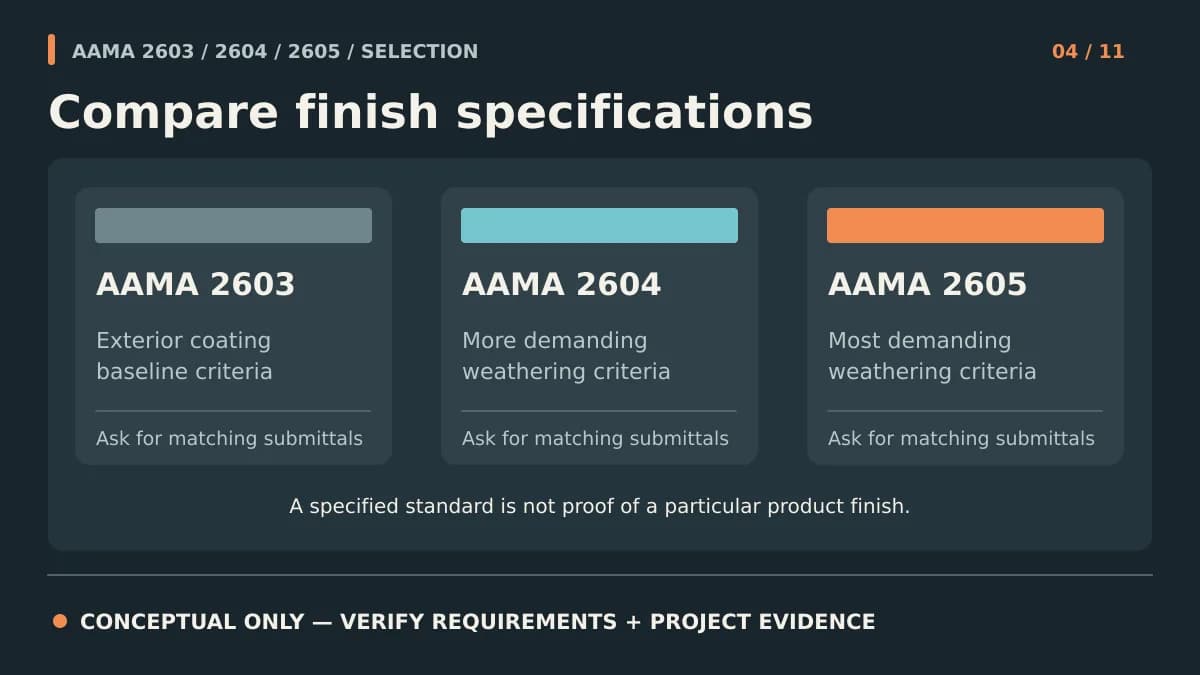
FGIA titles 2603 as a specification for pigmented organic coatings, 2604 for high-performance organic coatings, and 2605 for superior-performing organic coatings. Their tests and acceptance requirements address characteristics such as weathering, color and gloss retention, adhesion, and resistance to environmental exposure under defined methods. Higher-tier specification is often considered when long-term appearance and challenging exposure are priorities, but actual results depend on the formulation, application, pretreatment, substrate, orientation, and maintenance. Specify the edition rather than assuming all versions of the same number have identical criteria.
| Specification | FGIA description | Selection question | Evidence to request |
|---|---|---|---|
| AAMA 2603 | Pigmented organic coatings | Does this level fit the appearance and exposure brief? | Selected system compliance documentation |
| AAMA 2604 | High-performance organic coatings | Is enhanced exterior finish performance needed? | Test data and written finish schedule |
| AAMA 2605 | Superior-performing organic coatings | Does the project justify this performance class? | Testing for the actual coating system and edition |
Specify the System, Not Just the Number
A submittal should identify alloy or substrate, pretreatment, coating manufacturer and formulation, application method, primer if applicable, target film build, finish color and sheen, and the actual tested standard edition. Request production quality controls and documentation linking the proposed finish to the reported test system. A generic statement that “powder coating meets 2605” does not identify which formulation and color were assessed or whether that claim covers a separate wood-look decoration. Some coating technologies can be formulated to different performance classes; “powder” or “liquid” alone is not an AAMA tier. Confirm compatibility with repair methods and cleaning guidance.
AAMA Coating Standards Are Not Anodize Standards
Anodizing is an electrochemical surface treatment rather than an organic paint film. Distinguish coating, anodizing, and visual selection in the architectural aluminum finish selection guide. Do not ask an anodized finish to “pass AAMA 2605” as if these specifications were interchangeable; request the applicable anodizing specification and evidence instead. Likewise, a decorated or sublimated wood appearance may include a base organic coating plus a transferred pattern. Verify whether the stated test applies to the final decorated surface and whether any separate decorative layer is included. A color chip or physical sample is indispensable for aesthetic approval, but its attractive appearance alone cannot prove ultraviolet stability or resistance to salt exposure.
Exposure Changes the Specification
Discuss solar exposure, pollution, salt deposition, industrial contaminants, maintenance access, and sheltered surfaces with the coating supplier. A protected soffit may retain deposits longer than a rain-washed elevation. Coastal cladding conditions create questions about pretreatment, cut edges, dissimilar metals, and cleaning that no coating tier alone resolves. Establish acceptable appearance variation, color-control procedure, mockup lighting, and repair protocol at design stage. For a coastal project, inspect the entire finish and attachment strategy rather than assuming the highest-numbered coating automatically solves corrosion at every joint.
Evaluate Warranty Language Separately
Performance standards prescribe test methods and criteria; a commercial warranty defines who promises what, for how long, and subject to which exclusions. Check whether coverage applies to the exact color, coating, location, substrate, installation conditions, maintenance routine, and remedy. Ask about expected color variation between batches or replacement panels and how repairs are documented. Never substitute a stated standard for a manufacturer-backed warranty, and never infer a guaranteed service life from either. FGIA also publishes AAMA 609 & 610 guidance on cleaning architecturally finished aluminum; use finish-maker instructions for the actual system when planning cladding maintenance and cleaning.
Make Finish Approval Traceable
Keep the signed sample or project mockup, dated color reference, selected coating documentation, written cleaning instructions, and finish warranty with the construction record. Record which elevations receive the same system and which trims are finished by another process. For later repairs, matching a coating name alone may not reproduce gloss or pattern after years of weathering. If the submittal identifies only a standard number with no finish-specific report, ask for clarification before equating that claim with tested compliance. A well-defined finish schedule makes future maintenance and panel replacement more predictable without promising perpetual color stability. Ask whether cleaning or touch-up products may void coverage; an abrasive treatment that removes deposits quickly can also change sheen. Protect spare approved samples from weather so replacement panels can be compared to both the original reference and the aged façade.
Frequently Asked Questions
Is AAMA 2605 a lifetime guarantee?
No. It is a voluntary coating performance specification with defined tests. Actual exposure, maintenance, and any manufacturer's written warranty must be evaluated separately.
Does AAMA 2604 mean every powder-coated panel qualifies?
No. The specific coating system, substrate, application, and documentation must demonstrate the specified edition's requirements.
Should anodized aluminum be specified to AAMA 2605?
No. The 2603–2605 family addresses organic coatings. Request a relevant anodizing specification and evidence for anodized products.
Can a physical finish sample establish weathering performance?
No. It establishes appearance for approval; performance requires applicable test evidence for the proposed system.
Sources & Further Reading
- FGIA — AAMA 2603 Organic Coating Specification
- FGIA — AAMA 2604 High-Performance Organic Coating Specification
- FGIA — AAMA 2605 Superior-Performing Organic Coating Specification
- FGIA — AAMA 609 & 610-25 Cleaning and Maintenance Guide

About the author
Jay Zdun
Founder, Barcode Cladding
Jay Zdun is the founder of Barcode Cladding. He specializes in aluminum façade systems and helps architects, builders, and property owners evaluate profiles, finishes, and installation considerations for modern exterior projects.
Connect on LinkedIn