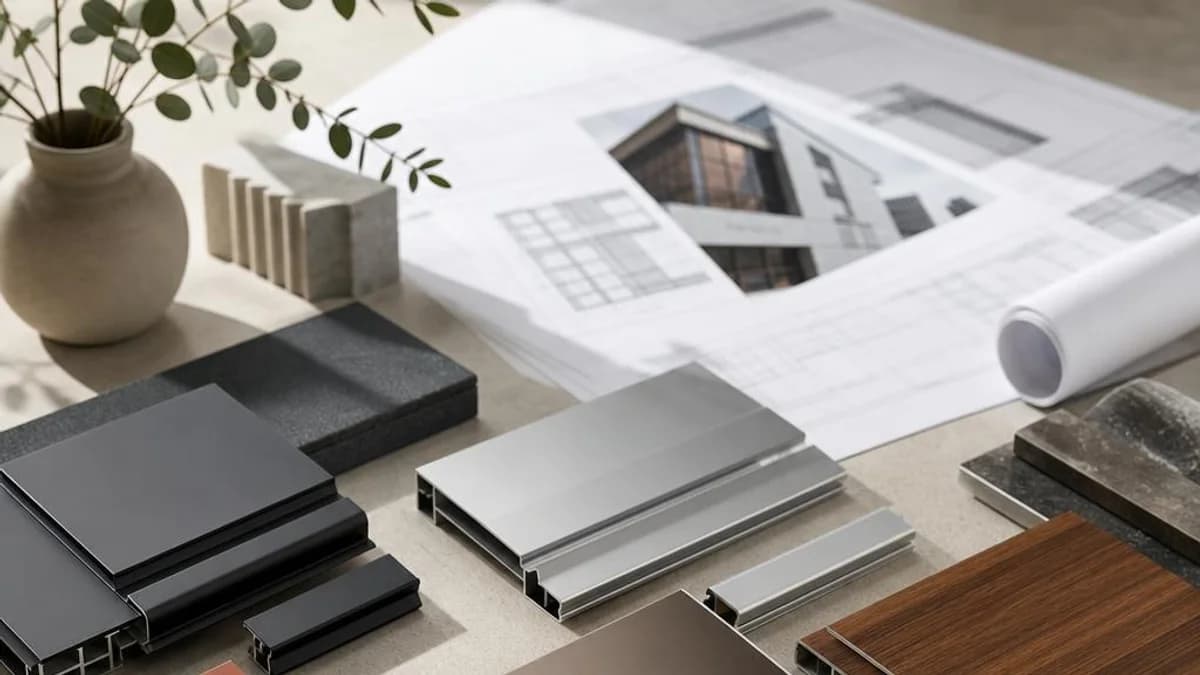
Powder coating offers broad color control, anodizing emphasizes aluminum's metallic character, and wood-look finishes add pattern and warmth. The right choice depends on design intent, exposure, approvals, and maintenance—not appearance alone.
Key Takeaways
- Choose powder coating when a controlled solid color, gloss range, or coordinated palette is the main design priority.
- Choose anodizing when metallic depth and the character of aluminum matter, while accepting that alloy, fabrication, and viewing conditions can make color variation visible.
- Choose a wood-look finish when a repeatable grain appearance is desired, then review pattern scale, repeat, orientation, base coating, and exterior-use documentation.
- Do not infer durability from a finish-family name. Specify the actual finish system, preparation, performance requirements, exposure, warranty, and approved samples.
- Approve physical samples and a representative mockup under project lighting before releasing production.
In short: powder coating is usually the most flexible route to a controlled solid color; anodizing preserves a distinctly metallic appearance; and wood-look transfer finishes add grain and visual warmth. No option is universally best. Select the finish by matching appearance, substrate and fabrication, environmental exposure, acceptable variation, cleaning plan, repair expectations, and supplier documentation. This article expands the finish step in the architectural aluminum cladding design guide.
First Decide What the Finish Must Accomplish
Write a short finish brief before comparing swatches. If the panel system is not yet settled, compare the exterior aluminum cladding system families before approving a finish. Record the target color or material expression, gloss or reflectance intent, expected viewing distance, elevation orientation, climate and pollutants, adjacent materials, acceptable variation, cleaning access, repair strategy, and approval method. A finish must work on the selected alloy and profile after forming, cutting, joining, and handling; an attractive chip alone does not establish that fit.
Powder-Coated Aluminum: Broad Color and Gloss Choice
Powder coating is a factory-applied organic coating that is deposited on prepared aluminum and cured. It is often shortlisted for solid colors, controlled gloss, textured effects, and coordination with other coated components. Performance depends on pretreatment, coating chemistry, film formation, application quality, edge and fabrication details, exposure, and maintenance. Use the applicable project specification and supplier evidence rather than treating every powder coating as equivalent.
- Best fit: solid colors, custom palettes, and projects seeking close coordination among coated components
- Review: pretreatment, coating system, color and gloss tolerances, exposed surfaces, cleaning guidance, warranty, and touch-up method
- Watch for: gloss or color differences among suppliers, difficult field repairs, and aggressive coastal or industrial exposure
Anodized Aluminum: Metallic Depth With Natural Variation
Anodizing is an electrochemical process that develops a controlled aluminum-oxide finish at the surface. It retains a metallic reading rather than covering the metal with an opaque color layer. That character can also reveal variation related to alloy, temper, extrusion or sheet source, fabrication, batch, surface condition, and light. FGIA's AAMA 611 specification addresses architectural anodic coatings, but the design team must still state the required appearance, class or performance criteria where applicable, and sample range.
- Best fit: clear, champagne, bronze, black, or other metallic architectural expressions
- Review: alloy and temper consistency, welds and mechanical finishing, color range, directional appearance, batch planning, and sample approval
- Watch for: visible lot variation, limits on exact color matching, and repairs that may remain apparent
Wood-Look Aluminum: Pattern, Scale, and Orientation Matter
Wood-look aluminum commonly uses a decorative image-transfer process over a compatible coated base. The result should be evaluated as a complete finish system, not as generic powder coating and not as real wood. Review pattern repeat, grain scale and direction, variation among pieces, base color, gloss, profile geometry, cut edges, exterior suitability, and supplier documentation. QUALIDECO publishes specifications for decoration of coated aluminum using sublimation or powder-on-powder techniques.
Finish Comparison Table
Use this table to identify a likely direction, then confirm the actual supplier system. It does not replace samples, technical data, warranties, or project-specific review.
| Decision factor | Powder-coated | Anodized | Wood-look |
|---|---|---|---|
| Visual character | Opaque color; broad color, gloss, and texture possibilities | Metallic depth that retains the character of aluminum | Printed grain or decorative pattern over a coated base |
| Variation to review | Color and gloss across batches, applicators, and component types | Alloy, temper, surface, batch, geometry, and viewing-angle variation | Pattern repeat, scale, direction, base color, and piece-to-piece layout |
| Specification focus | Pretreatment, coating system, performance criteria, color, gloss, film and cure documentation | Applicable anodizing requirements, alloy coordination, color range, finish direction, approved samples | Complete base-coat and decoration system, exterior suitability, pattern control, approvals |
| Repair reality | Field touch-up may differ in color, gloss, texture, and weathering | Localized repair may remain visible and may require unit replacement | Pattern and color matching can make localized repair difficult |
| Strong reason to shortlist | Controlled solid color and palette flexibility | Authentic metallic appearance | Wood-like visual warmth without specifying wood at the cladding face |
Match the Finish to Exposure and Maintenance
Orientation, ultraviolet exposure, salt, humidity, industrial contaminants, runoff, recesses, and cleaning access can change finish demands. Ask the finish supplier for current data that applies to the proposed substrate, color, gloss, profile, application line, and environment. Coordinate cleaners, sealants, gaskets, fasteners, treated lumber, and adjacent metals. Establish inspection and cleaning procedures from the finish supplier instead of calling any exterior finish maintenance-free.
A cited standard identifies test methods and requirements; it does not by itself prove that an unnamed product, color, or complete wall assembly complies.
Samples, Mockups, and Finish Schedule
Approve the decision in stages. Begin with current physical samples, compare them outdoors and under representative interior reflections, and then build a representative mockup large enough to show panel width, joints, corners, trims, fasteners, sealants, and transitions. Order aluminum finish samples when comparing Barcode options in the intended light. Record the approved sample, acceptable range, viewing criteria, production batch strategy, protection requirements, and responsibility for substitutions.
Limitations and Questions to Resolve Before Approval
Small samples cannot predict the appearance of an entire elevation, and accelerated tests do not equal a guaranteed service life. Dark colors, metallic surfaces, gloss, texture, extrusion geometry, fabrication, and directional light can change perception. Field touch-up rarely reproduces a factory finish exactly. Wood-look graphics can repeat, and anodized components can vary. Product availability and Barcode-specific colors, performance evidence, warranties, lead times, and care instructions must be confirmed directly from current product documents.
- Has the exact finish system been approved for the proposed aluminum and fabrication sequence?
- What range of color, gloss, texture, or pattern variation is acceptable?
- Does submitted evidence cover the actual color and exposure rather than a different system?
- How will damaged units be repaired or replaced, and should attic stock be retained?
- Who approves the mockup and controls substitutions after approval?
The Bottom Line
Choose powder coating for broad solid-color control, anodizing for metallic character, or wood-look finishing for a decorative grain expression—but specify the complete system rather than the category name. Whether the finish appears on wall panels, dimensional battens, or overhead soffits, a defensible selection is supported by project exposure, supplier data, coordinated details, approved samples, and a representative mockup.
Barcode Cladding can provide current product-level samples and finish information. The architect or responsible design professional remains responsible for project requirements, compatibility, code review, and final approval.
Frequently Asked Questions
Is powder-coated or anodized aluminum better for exterior cladding?
Neither is universally better. Powder coating offers broad opaque color and gloss choices; anodizing preserves metallic character. Compare the actual systems for exposure, acceptable variation, fabrication, maintenance, warranty, repair strategy, and the project's appearance goals.
Does anodized aluminum have color variation?
It can. Alloy, temper, source material, surface condition, fabrication, batch, geometry, and lighting may affect appearance. Define an acceptable range, coordinate material lots where practical, and approve representative samples and a mockup.
Is wood-look aluminum the same as powder coating?
Not necessarily. A wood-look system may use a compatible powder-coated base plus a sublimated image transfer, or another qualified decorative process. Request documentation for the complete base and decoration system rather than assuming the pattern alone establishes performance.
Can aluminum cladding finishes be touched up in the field?
Minor damage may have an approved repair procedure, but field-applied material can differ from the factory finish in color, gloss, texture, pattern, and weathering. Agree on acceptance criteria and when replacement is preferable before installation.
Sources & Further Reading
- FGIA — AAMA 611 Specification for Anodized Architectural Aluminum
- FGIA — AAMA 2604 Specification for High Performance Organic Coatings
- QUALIDECO — Specifications for Decoration of Coated Aluminum
- FGIA — Cleaning and Maintenance Guide for Finished Aluminum

About the author
Jay Zdun
Founder, Barcode Cladding
Jay Zdun is the founder of Barcode Cladding. He specializes in aluminum façade systems and helps architects, builders, and property owners evaluate profiles, finishes, and installation considerations for modern exterior projects.
Connect on LinkedIn