
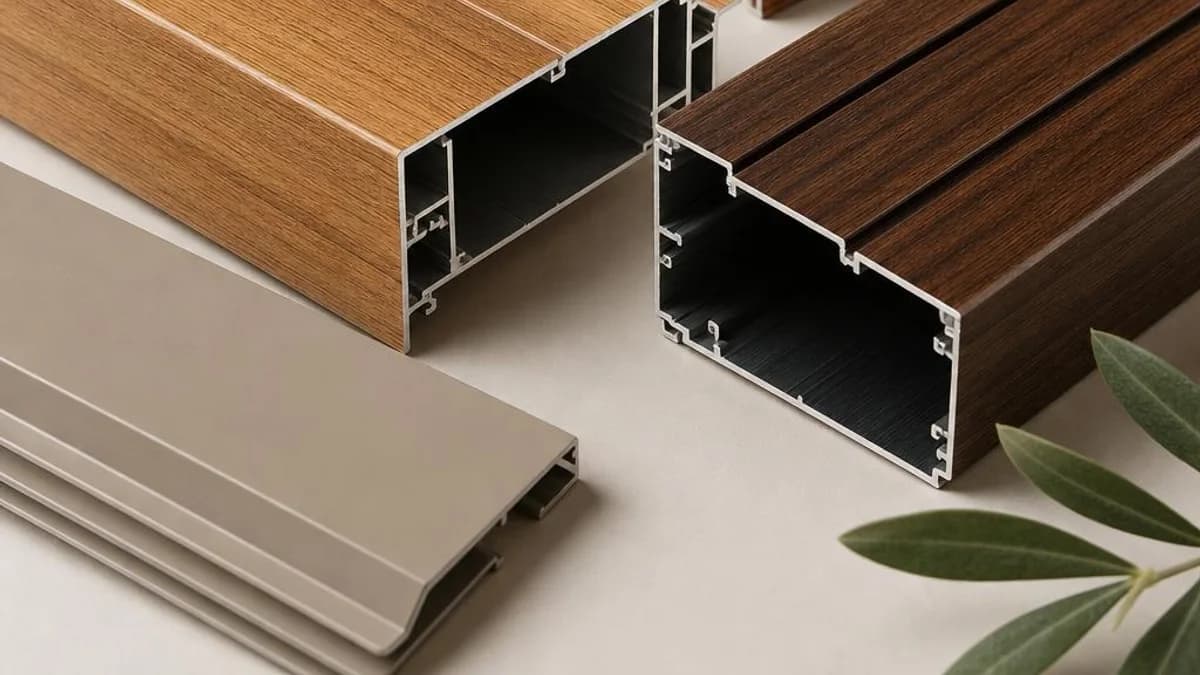
Wood-look aluminum is a decorated coating system, not wood and not a generic material property. Understanding the base coat, transfer method, pattern repeat, qualification, and approval process helps teams specify it responsibly.
Key Takeaways
- Wood-look aluminum is a decorative finish system over aluminum; it does not reproduce the anatomy, aging, or randomness of real wood.
- In sublimation-based systems, a printed transfer medium is used with a compatible coated substrate under controlled production conditions.
- Verify the complete base-coat and decoration system, exterior-use qualification, approved applicator, pattern, gloss, and warranty.
- Review full-size samples for grain scale, direction, repeat, color range, edges, and appearance on the selected profile.
- Treat Barcode colors, process details, performance data, care instructions, and availability as current product data that must be confirmed directly.
In short: a wood-look sublimation finish uses a decorative transfer process on a compatible coated aluminum substrate to create a grain image. It can provide a repeatable wood-like appearance while retaining an aluminum cladding face, but it is not real wood and its performance cannot be inferred from the word “sublimation.” Specify and approve the complete system, current supplier evidence, pattern, application, and limitations as part of the architectural cladding design workflow.
What Sublimation Means in This Context
Sublimation describes a transfer mechanism in which suitable colorants move from a printed transfer medium into a compatible coating during a controlled production cycle. Exact temperatures, dwell times, pressure or vacuum methods, inks, films, and coating chemistry vary by qualified system and applicator. The QUALIDECO decoration specifications address qualification of decoration methods; a single generic recipe should not be substituted for the finish supplier's process controls.
The Finish Is a System, Not Just an Image
The aluminum substrate, preparation, base coating, decoration materials, production line, cure and transfer controls, profile geometry, and quality checks work together. The base color affects the final wood tone, while gloss and texture affect how the grain reads in changing light. Ask for documentation naming the complete approved system and applicator; do not combine a base coat and transfer film merely because each is marketed for exterior use.
| System element | Why it matters | What to request |
|---|---|---|
| Aluminum and preparation | Surface condition supports coating adhesion and appearance | Applicable substrate and pretreatment information |
| Base coating | Provides color and the receptive layer for decoration | Named coating system, color, gloss, and exterior-use documentation |
| Transfer materials | Create the decorative image and color range | Approved film or paper and ink combination for the system |
| Applicator and process | Controlled production affects repeatability | Current qualification, quality-control information, and sample record |
| Finished product | Geometry and fabrication can affect appearance | Representative samples, acceptable range, warranty, and care guidance |
Pattern Repeat, Scale, and Direction
Unlike natural boards, a transferred graphic comes from a finite pattern. Repeats may become noticeable on broad, uniformly lit elevations or when identical pieces align. Grain direction usually follows the decorated component's production orientation, but that must be confirmed for the selected profile and fabrication. Ask for repeat dimensions or representative production samples where available, and use an elevation layout or mockup to manage obvious repetition.
- Review the grain at the intended viewing distance as well as close up.
- Confirm how horizontal, vertical, corner, trim, and soffit pieces will orient.
- Agree on whether controlled variation or close matching is the design intent.
- Include cut edges, end conditions, joints, and replacement pieces in the review.
Exterior Performance Must Be Verified
Weathering depends on the complete decorated system, colorants, base coat, preparation, application, orientation, ultraviolet exposure, moisture, salts, pollutants, cleaning, and damage. A performance designation for an undecorated base coating does not automatically establish the behavior of the final wood-look system. Request current test or qualification documents that apply to the decorated product, plus warranty terms and maintenance instructions. Accelerated testing is comparative evidence under stated conditions, not a promise of a specific field service life.
Do not convert test hours into years of outdoor life unless the responsible standard or supplier provides a valid, project-applicable basis for doing so.
How Wood-Look Aluminum Compares With Other Choices
Wood-look aluminum offers a wood-referencing graphic on an aluminum component. Real wood provides authentic grain, depth, variation, and weathering but requires species-, detail-, exposure-, and finish-specific care; the broader aluminum-versus-wood siding comparison addresses those material tradeoffs. Solid-color coated or anodized aluminum avoids graphic repeat and may better express metal; powder-coated, anodized, and wood-look finishes have distinct approval questions. Printed vinyl, laminates, fiber cement, and composites are separate product families whose fire, movement, moisture, attachment, repair, and maintenance characteristics must be compared using actual product data—not generic material claims.
What to Put in the Finish Specification
- Named aluminum product, profile, substrate, preparation, and complete decoration system
- Wood pattern, base color, gloss, texture, grain direction, and acceptable range
- Exterior-use qualification and test documentation for the complete decorated system
- Approved applicator and requirements for production quality control
- Physical samples and a mockup showing repeats, joints, corners, trims, and adjacent materials
- Protection, cleaning, repair, touch-up, replacement-stock, and warranty requirements
Review Barcode Options With Current Product Data
This article provides general editorial guidance and does not define Barcode's proprietary finish construction, available patterns, test results, lead times, warranty, maintenance instructions, or grain orientation. Those are product facts that should come from current documents for the selected aluminum cladding panels. Review actual wood-look aluminum samples for grain, color, gloss, profile, and repeat in project lighting, and request confirmation for the selected application and exposure before specification.
Limitations to Resolve Before Approval
A small sample cannot show pattern repetition across a full elevation. Screens and photographs cannot reliably communicate gloss, texture, color range, or changing light. Cut edges and field repairs may not continue the grain, and replacement pieces may differ from earlier production. Curves, deep profiles, welded assemblies, long components, or mixed orientations may constrain the decoration process. Confirm these conditions with the finish supplier and fabricator, and use a project mockup where appearance is consequential.
Frequently Asked Questions
Is wood-look aluminum made of real wood?
No. It is an aluminum component with a decorative finish intended to reference wood grain. It does not have real wood's anatomy, random variation, tactile character, or natural weathering.
Is a wood-look sublimation finish a vinyl wrap?
A sublimation-based finish is generally a transfer into a compatible coating rather than a film intentionally left as the exposed surface. However, products use different methods, so request documentation identifying the actual finish construction instead of relying on the marketing name.
Will wood-look aluminum fade outdoors?
Any exterior color can change with exposure. The amount depends on the complete finish system, colorants, orientation, climate, cleaning, and other conditions. Review exterior-use qualification, applicable test data, warranty terms, and approved samples for the exact decorated system.
How should architects approve a wood-look aluminum finish?
Approve current physical samples and an acceptable range, then use a representative mockup to review grain scale, direction, repeat, gloss, profile, joints, corners, trims, edges, sealants, and adjacent materials under relevant lighting.
Sources & Further Reading
- QUALIDECO — Specifications for Decoration of Coated Aluminum
- QUALICOAT — Powder Coating Specifications
- FGIA — AAMA 2604 Specification for High Performance Organic Coatings
- FGIA — Cleaning and Maintenance Guide for Architecturally Finished Aluminum

About the author
Jay Zdun
Founder, Barcode Cladding
Jay Zdun is the founder of Barcode Cladding. He specializes in aluminum façade systems and helps architects, builders, and property owners evaluate profiles, finishes, and installation considerations for modern exterior projects.
Connect on LinkedIn