
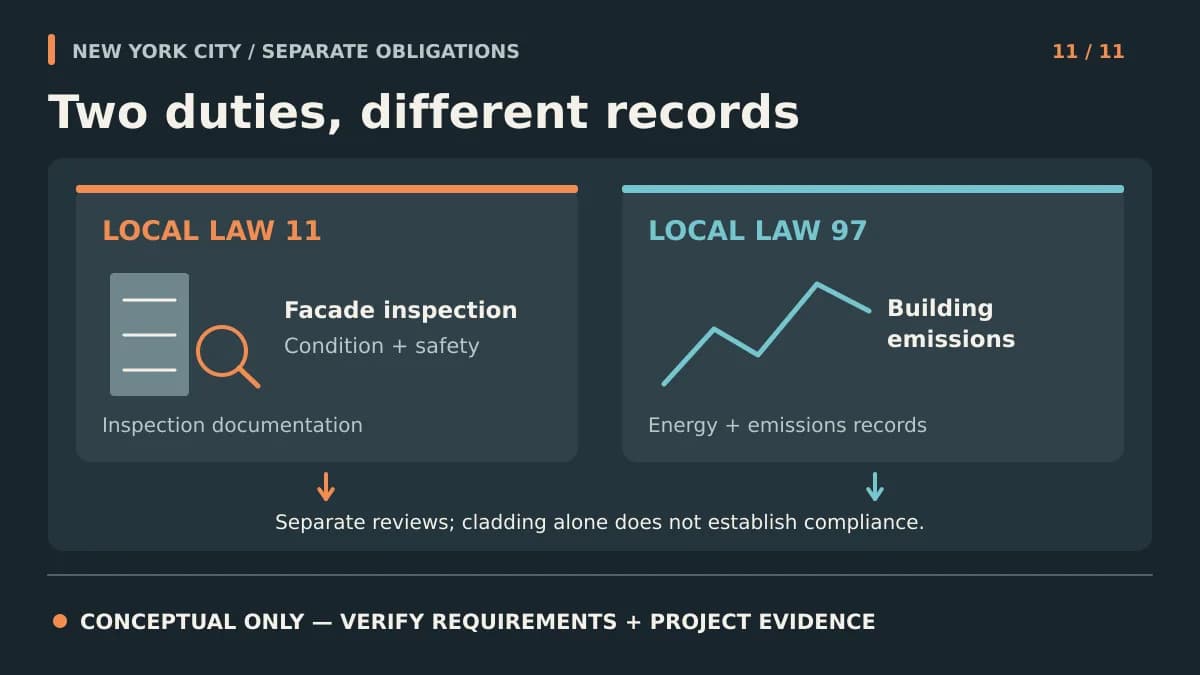
A façade repair may be an opportunity to study energy upgrades, but FISP and LL97 have separate triggers, professionals, filings, and evidence.
Key Takeaways
- FISP addresses the condition of exterior walls and appurtenances on buildings higher than six stories; LL97 addresses emissions and reporting for covered buildings.
- A building can be subject to one law, both, or neither; confirm each independently rather than assuming a façade project triggers both.
- Overcladding does not erase unsafe conditions or replace the required QEWI inspection and DOB filings.
- An exterior insulation strategy may contribute to modeled energy savings, but cladding alone does not calculate or guarantee LL97 compliance.
In New York City, 'Local Law 11' is commonly used as shorthand for the Façade Inspection & Safety Program (FISP), while Local Law 97 (LL97) sets greenhouse-gas requirements for covered buildings. Their shared geography can make a single façade project seem like a shortcut to two approvals. It is not. An owner can coordinate access and design work, but must still establish two different compliance pathways with the appropriate professionals and filings. The broader cladding performance, codes, and lifecycle framework separates code, test, and ownership questions; aluminum cladding is a potential exterior finish within the NYC project, not a substitute for diagnosing the existing wall or documenting building emissions.
FISP: Inspection and Correction of Façade Conditions
NYC Department of Buildings (DOB) guidance says owners of buildings higher than six stories must have exterior walls and appurtenances inspected every five years and file a technical façade report through DOB NOW: Safety. The report is filed by a Qualified Exterior Wall Inspector (QEWI), a registered design professional meeting DOB's qualification requirements. The inspection records conditions, not merely the look of the outer surface. A new screen installed over deteriorated masonry is not itself proof that loose material, distressed supports, or water-damaged backup construction have been made safe.
Do Not Conceal a Defect Behind a New Skin
A responsible retrofit begins with the QEWI's condition findings and an investigation of the wall that will remain. Repair scope, permits, special inspections, landmark review where relevant, and the next inspection access strategy should be planned before selecting a screen profile. If the report identifies unsafe conditions, the owner must follow DOB's applicable protection, notification, repair, and amended-filing process; a proposed cladding system is not a classification of 'safe.' Make inspection of previously concealed elements possible where required, and keep a clear record of what was removed, retained, repaired, and covered. Ask how future inspectors will examine appurtenances and critical transitions without destructive guessing.
LL97: Building Emissions, Not Panel Chemistry
DOB describes LL97 coverage as generally including a building over 25,000 gross square feet, certain buildings on the same tax lot totaling over 50,000 square feet, and certain condominium buildings under one board totaling over 50,000 square feet. The law provides different pathways, including Article 320 for most private covered buildings and Article 321 for certain affordable housing and houses of worship. Under Article 320, a registered design professional certifies annual emissions reporting. Article 321 instead has applicable prescriptive or alternative compliance routes and associated filings; do not assume its requirements are the same as an Article 320 annual emissions report. Coverage and the correct pathway require confirmation for the specific building; appearing on or missing from DOB's covered-buildings list does not alone relieve an owner of responsibility.
Where a Coordinated Project Can Make Sense
Façade access is expensive and disruptive, so an owner may reasonably ask whether repairs and an enclosure improvement can share a project window. Compare access, capital, and future maintenance scenarios in an aluminum cladding lifecycle-cost analysis. Exterior insulation and air-control improvements may be studied while the façade is already opened. But their effects depend on the existing assembly, thermal bridges, penetration detailing, actual heating and cooling systems, and the building's measured or calculated emissions. A replacement cladding layer without verified insulation and continuity details does not establish energy savings. Have an energy consultant quantify alternatives against the building's LL97 pathway while the enclosure designer resolves moisture, structure, fire, and access needs.
Decision Table: Keep the Two Reviews Separate
| Question | FISP / LL11 path | LL97 path |
|---|---|---|
| Is the building covered? | Confirm story count and inspection cycle with DOB | Verify covered-building status and Article 320 or 321 pathway |
| Who signs off? | Qualified Exterior Wall Inspector files the façade report | Article 320: registered design professional certifies annual emissions reporting; Article 321: confirm the applicable prescriptive or alternative route and filing requirements |
| What does a panel demonstrate? | Appearance and a component of a designed repair, not wall safety | An exterior finish, not measured emissions reduction |
| What should be retained? | Inspection, repairs, permits, and access records | Article 320: emissions data and annual filing records; Article 321: evidence for the applicable compliance route and its filing |
Design the Overcladding as an Actual Wall
A concept elevation cannot answer whether the existing wall can support added dead load and wind loads. The design team must determine substrate capacity, anchors, insulation and moisture-control sequencing, fire requirements, movement, drainage, and how to inspect concealed or projecting elements later. Coordinate air and water barriers behind cladding with those concealed layers. In particular, a metallic outer face does not establish compliance with any assembly-level fire requirement; material and wall-assembly fire tests answer different questions. Ask for a drawing that identifies each layer and the applicable tests for the selected configuration, then get DOB and other required agency reviews. Product samples can verify appearance, but cannot verify structural attachment, energy performance, or code approval.
A Practical Owner's Sequence
First, ask the QEWI for the current façade report, defect inventory, and interim safety measures. Second, ask the LL97 team to confirm covered status, compliance article, baseline emissions, and modeled impact of each proposed energy measure. Third, have an enclosure professional and structural engineer investigate the existing wall and develop options that can be permitted and inspected. Only then compare finish profiles, including relevant aluminum cladding panel options, repair phasing, and access costs. Keep the façade and energy deliverables in one coordination matrix but two compliance files: shared scaffolding is not shared proof of compliance.
Frequently Asked Questions
Does a FISP repair automatically count as LL97 compliance?
No. FISP evaluates exterior-wall safety, while LL97 has separate coverage and compliance pathways. Article 320 requires annual emissions reporting certified by a registered design professional; Article 321 has applicable prescriptive or alternative compliance and filing requirements. A façade repair alone establishes neither pathway.
Can new cladding hide masonry defects identified by a QEWI?
No. The repair design must address the underlying conditions and meet DOB's applicable requirements; simply covering a defect does not change its safety status.
Does LL97 apply to every building that files a façade report?
No. FISP's height-based trigger differs from LL97's covered-building definitions and special pathways. Verify each independently with the relevant professional and DOB guidance.
Does an aluminum panel reduce a building's reported emissions?
A finish alone provides no quantified reduction. An integrated insulation or air-control measure may affect energy use, but the team must model and document its effect alongside building systems and actual LL97 reporting.
Sources & Further Reading

About the author
Jay Zdun
Founder, Barcode Cladding
Jay Zdun is the founder of Barcode Cladding. He specializes in aluminum façade systems and helps architects, builders, and property owners evaluate profiles, finishes, and installation considerations for modern exterior projects.
Connect on LinkedIn