
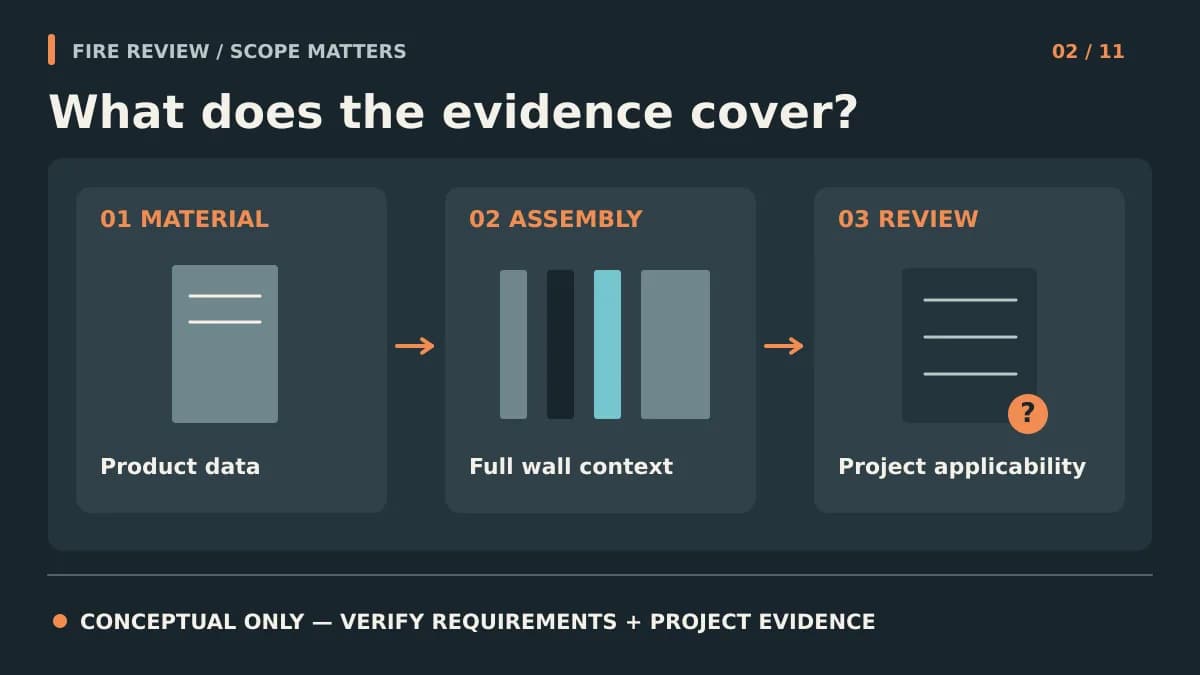
A surface-burning number, a noncombustibility test, and a full-scale wall fire test answer three different questions. Learn which evidence to request.
Key Takeaways
- ASTM E84 compares surface burning; it does not classify a product as noncombustible or validate an exterior-wall assembly.
- ASTM E136 assesses the combustibility of a tested material specimen, not the behavior of every component in a proposed wall.
- NFPA 285 evaluates fire propagation of a specific exterior-wall configuration containing combustible components.
- Ask the design professional and authority having jurisdiction which code provisions apply, then match the proposed construction to the actual test evidence.
“Fire rated aluminum cladding” can sound reassuring while leaving the essential question unanswered: rated for what, in which wall, under which code provision? An aluminum facing may be one layer among coatings, insulation, membranes, attachments, and backup construction. Fire behavior cannot be inferred from the word aluminum alone. Start with the governing code and the complete wall section, then ask which test addresses each required characteristic in the broader performance, codes, and lifecycle verification process. This guide is a document-review map, not an assertion that any Barcode assembly has passed one of these tests.
Three Tests, Three Different Questions
ASTM describes E84 as a comparative measurement of surface flame spread and smoke developed under its prescribed test conditions. It expressly does not establish noncombustibility or describe all behavior in an actual fire. E136 exposes a material specimen to a vertical tube furnace at 750°C; material meeting its criteria is typically classified as noncombustible. Neither result says that a wall with insulation, air/water barrier, attachments, and openings limits exterior fire propagation. NFPA describes NFPA 285 as a test method for fire propagation characteristics of exterior-wall assemblies containing combustible materials or components. A report must identify the wall as tested, not merely name the outer facing.
| Method | Question answered | Does not establish | Request |
|---|---|---|---|
| ASTM E84 | Surface flame spread and smoke indices for tested material | Noncombustibility or complete wall approval | Specimen description and complete report |
| ASTM E136 | Combustibility of tested material under furnace conditions | Approval of coatings, insulation, or wall as a whole | Material identity and full report |
| NFPA 285 | Fire propagation for tested exterior-wall configuration | Blanket approval of dissimilar walls | Assembly report and permitted variations |
Code Trigger Comes Before Test Shopping
Do not order a test by acronym without identifying the adopted code edition, occupancy, building height, construction type, wall materials, and any applicable exceptions. NFPA 285 is referenced by building codes in particular exterior-wall circumstances; it is not a universal requirement for every aluminum panel or every building. The code official may also require evidence for separate issues such as interior finish, insulation, fire resistance, or Colorado wildland-urban-interface exposure. An E84 number cannot substitute for an NFPA 285 assembly where that assembly method is required. Conversely, a full-scale test does not automatically replace independent product-specific requirements elsewhere in the code.
Read the Assembly Report, Not Just a Cover Letter
Request the full report, the laboratory and applicable edition, construction drawings, and any legitimate engineering analysis addressing substitutions. Compare outer material and thickness, coating or core, insulation type and thickness, air and water barriers behind the cladding, sheathing, framing, attachment, cavity, joint details, and opening construction with the project schedule. If any listed item changes, ask the qualified fire consultant or evaluation body whether the change is supported. A pass claim attached to another manufacturer's different construction is not transferable by visual similarity. “Meets NFPA 285” is incomplete unless the proposed configuration and its supported variations are identifiable.
What to Ask a Cladding Supplier
Provide the proposed profile, finish, substrate, insulation, membrane, and detail schedule, and request current documentation specific to those selections. A supplier may offer product identification or tested assembly information, but the architect and code professional still need to verify that the evidence matches the construction under the jurisdiction's adopted rules. Product samples show color, texture, and shape; they cannot demonstrate flame-spread indices, noncombustibility, or propagation resistance. Keep wind-load and attachment testing as a separate structural evidence request. If a test report is unavailable, mark the requirement unresolved rather than filling the gap with a marketing description.
A Practical Approval Sequence
First, draw the actual wall and list every material in order from outside to inside. Second, have the architect identify applicable provisions and ask the authority having jurisdiction about uncertain triggers. Third, collect full test and evaluation documents, not isolated performance labels. Fourth, make a comparison matrix of tested and proposed components, including concealed items. Fifth, obtain documented review of deviations before issuing construction documents. Finally, control substitutions on site: a late membrane or insulation change can invalidate an earlier assembly comparison even if the visible cladding remains unchanged. Keep this evidence in the submittal package for future maintenance and alterations. Note the distinction between exterior fire propagation and a fire-resistance rating: a test of one characteristic does not grant a rated hourly separation or exempt another prescribed test. At construction closeout, give the owner the actual approved assembly schedule so a future recladding project can check what was originally accepted.
Frequently Asked Questions
Does an ASTM E84 Class A result mean a wall passes NFPA 285?
No. E84 measures surface burning of a specimen under a prescribed method. NFPA 285 addresses fire propagation of an exterior-wall assembly. They are not interchangeable.
Is aluminum automatically a noncombustible wall assembly?
No. A metal facing does not classify coatings, membranes, insulation, or the complete construction. Assess material and assembly requirements independently.
Can a sample panel prove fire compliance?
No. Samples help approve appearance only. Ask for the applicable complete test report and a documented match to the proposed construction.
Who decides whether NFPA 285 applies?
The design and code team determines requirements from the adopted code and project conditions, with interpretation by the authority having jurisdiction.
Sources & Further Reading
- ASTM — E84 Surface Burning Characteristics of Building Materials
- ASTM — E136 Assessing Combustibility of Materials
- NFPA — NFPA 285 Standard Development and Scope

About the author
Jay Zdun
Founder, Barcode Cladding
Jay Zdun is the founder of Barcode Cladding. He specializes in aluminum façade systems and helps architects, builders, and property owners evaluate profiles, finishes, and installation considerations for modern exterior projects.
Connect on LinkedIn