
Colorado's wildfire rules are not a blanket certification for any metal panel. Begin with the jurisdiction and map, then review the entire wall and its details.
Key Takeaways
- Colorado's statewide minimum code is implemented through governing bodies; confirm the adopted local code and the authority having jurisdiction (AHJ) before designing.
- The official map and any adopted local map establish the relevant WUI and fire-intensity designation; the address alone does not tell you which details apply.
- An aluminum face does not certify the finish, backing, insulation, cavity, attachments, or full wall assembly for a specific requirement.
- Request project- and product-specific evidence rather than treating a finish sample or generic material statement as a fire-test report.
An aluminum exterior can be one part of a Colorado wildfire-resilience strategy. It cannot, by itself, settle a permit review. The 2025 Colorado Wildfire Resiliency Code (CWRC) addresses mapped wildfire hazard, structure hardening, and site conditions; the applicable local code and the authority having jurisdiction determine what must be shown for a particular project. Apply the broader performance, codes, and lifecycle verification framework while separating three questions for a mountain home or commercial building: Is the parcel within a regulated area? Which hardening class applies? Does the proposed wall, including all its layers and edges, meet the applicable provisions?
First Establish the Actual Governing Code
Colorado's Division of Fire Prevention and Control publishes the CWRC and a statewide fire-intensity map. The state's resiliency office explains that governing bodies implement the state minimum or adopt provisions that go beyond it; its May 2026 account describes a June 30, 2026 local implementation deadline and examples of jurisdictions taking different approaches. A statewide minimum is not a substitute for checking the city's or county's currently adopted text. Municipal and unincorporated areas can have different rules even when they share a county name. Before relying on any date quoted in a marketing article, ask the permit counter which edition, amendments, effective date, and transition provisions govern the actual permit application.
Map the Site Before Choosing a Material
The CWRC's Chapter 3 provides for WUI designations and fire-intensity classifications of low, moderate, and high. Section 303 allows an AHJ to develop and adopt local mapping. An online statewide map is a useful first screen, not an approval letter for an individual parcel. Ask whether the local map supersedes or supplements it, whether the parcel crosses a boundary, and whether a site determination or ground-truthing process is available. Document the map version and jurisdictional interpretation in the project file. The code also distinguishes construction work by scope; do not assume a repair, addition, or existing building has the same trigger as new construction without checking the applicable provisions and local interpretation.
Understand the Material Routes Without Inventing a Rating
The CWRC's Chapter 4 addresses structure hardening. Section 402 recognizes different building-material routes, including noncombustible material, exterior-use fire-retardant-treated wood, and qualifying ignition-resistant material. These are alternatives with distinct definitions and evidence requirements, not a declaration that every component of every wall must be aluminum. Sections 403 and 404 then set out requirements for different hardening classes and building elements. A bare metal extrusion, a coated profile, a composite panel with a core, and a completed wall assembly are different things; distinguish material tests from assembly fire evidence. Do not describe a Barcode profile as ASTM E136-tested, noncombustible under a specific code definition, or approved for a CWRC class without the current selected-product documentation and AHJ acceptance.
Look Beyond the Broad Wall Plane
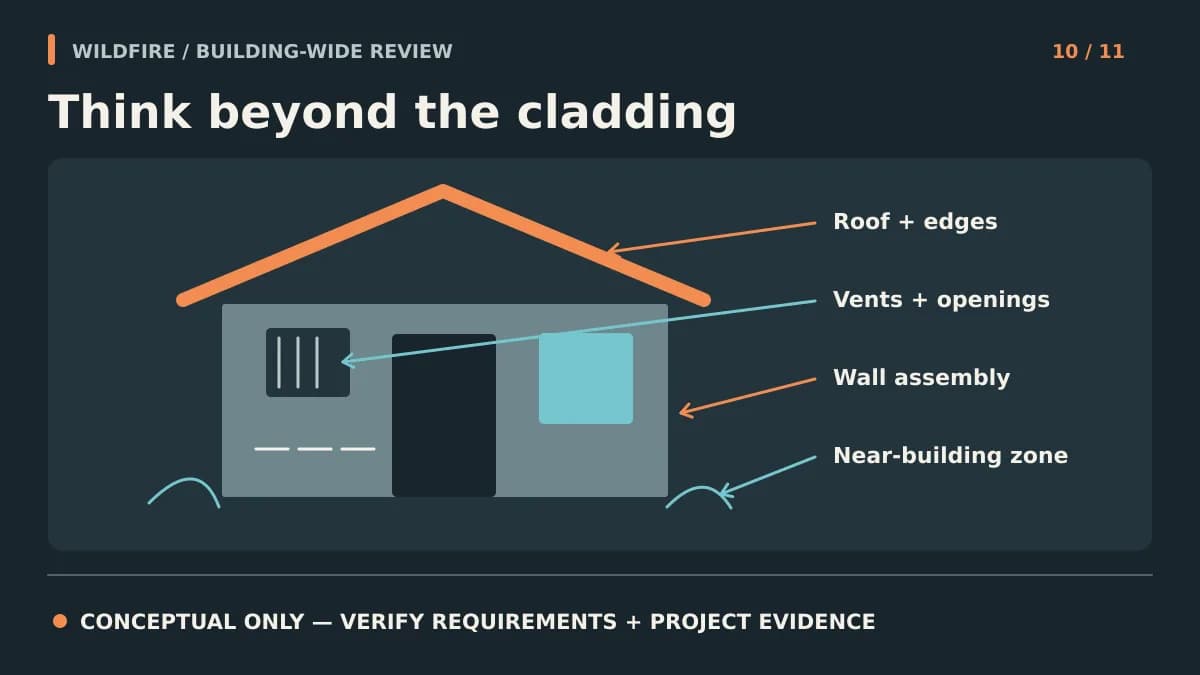
Wildfire vulnerability concentrates at intersections: roof-to-wall junctions, vents, openings, soffits, exposed cavity ends, decks, and the base of a wall. A panel choice does not control ember entry behind a cladding screen. The architect should show what closes or screens openings, how cavity terminations are detailed, and which tested or listed components are required by the governing code. Fire and moisture detailing must also be coordinated with air and water barriers behind cladding: an opening intended to drain a rainscreen should not be arbitrarily sealed without redesigning the water-management path. Vegetation and combustible storage immediately adjacent to the building are site issues, not problems that can be cured by a metal finish alone.
Decision Table: What to Check at Each Stage
| Decision | Evidence to request | Who confirms |
|---|---|---|
| Is this site regulated? | Parcel designation, state and adopted local maps | Local AHJ |
| Which rules apply to this scope? | Adopted code, amendments, permit date and work classification | Local AHJ and design professional |
| Can this cladding be specified? | Exact profile and finish data, relevant material or assembly reports | Design professional with AHJ review |
| Are interfaces resolved? | Wall sections, cavity closures, openings, roof and site details | Enclosure and fire design team |
Specify the Exact Assembly, Not an Aesthetic Proxy
A useful submittal request identifies the selected profile and finish, the substrate and insulation, the water- and air-control layers, supports, fasteners, cavity geometry, perimeter details, and any relevant reports. State precisely which test or listing applies to which configuration; do not transfer a result from one product or assembly to another. Samples of Barcode's aluminum cladding panels are appropriate for checking color, texture, and profile appearance. They do not establish fire classification, installation approval, or a service-life prediction. If documentation is unavailable, mark the performance question as unresolved and select a verified alternative or obtain the necessary evaluation before submitting for approval.
Plan for Use and Upkeep After Approval
The permitted design is only the starting condition. Owners should preserve approved drawings and product identification, inspect debris accumulation near walls and openings, and maintain the site in accordance with local requirements. Cleaning access and replacement details belong in the cladding maintenance and repair plan because exposed finishes can be scratched or altered by inappropriate products. After any repair, confirm that a substituted panel or closure preserves the approved design assumptions. This is especially important where a later trade changes a soffit, cuts a vent, or installs services through the wall.
Frequently Asked Questions
Does Colorado's wildfire code apply everywhere in the state?
No universal parcel conclusion follows from the state code alone. Check the adopted jurisdictional code, effective date, local or state mapping, and the nature of the proposed work with the AHJ.
Is every aluminum panel automatically CWRC compliant?
No. The governing provision may require evidence about the selected material or the full construction. A metal face does not establish the properties of coatings, cores, backing, or adjoining details.
Will a finish sample prove noncombustibility?
No. Samples show appearance. Request current reports and product identification for the selected configuration, then have the design professional and AHJ evaluate them against the applicable code.
What if the local map disagrees with the state map?
Ask the AHJ which adopted map controls and document its parcel determination before finalizing the wall specification. The CWRC allows locally developed mapping.
Sources & Further Reading

About the author
Jay Zdun
Founder, Barcode Cladding
Jay Zdun is the founder of Barcode Cladding. He specializes in aluminum façade systems and helps architects, builders, and property owners evaluate profiles, finishes, and installation considerations for modern exterior projects.
Connect on LinkedIn