
Accurate material takeoffs prevent costly mid-project shortages and over-ordering. Here's the complete methodology for estimating aluminum cladding quantities on any project.
Material quantity estimation for aluminum cladding projects is more systematic than it might appear. Under-order and you're waiting on a re-run while your crew sits idle. Over-order and you've tied up capital in material that won't be used. The architectural cladding design workflow establishes the module and details that a takeoff must reflect. Here's the complete methodology — the same approach our team uses when reviewing architect takeoffs.
Step 1: Calculate Gross Wall Area
Start with the total exterior wall area to be clad. For each elevation, multiply the width by the height. Add all elevations together for the gross wall area. Use finished dimensions (from grade or finish floor to top of cladding line), not structural dimensions. Map those elevations against the chosen aluminum panel profiles before calculating coverage.
Step 2: Subtract Openings
Deduct openings at the actual cladding termination lines on the coordinated elevation—not automatically at rough-opening dimensions or the nominal window size. A recessed reveal, return, sill or head can change the clad area and cut lengths. Measure returns separately, record which surfaces receive panels, and count opening trims independently. A net-area deduction does not prove the corresponding stock material can be saved: a window may turn one continuous course into two shorter cuts.
Step 3: Apply a Waste Factor
For early budgets, identify an explicit provisional cutting and handling allowance, then replace it with a stock-cut schedule as the layout develops. There is no universal minimum waste percentage. Orientation, stock length, opening positions, patterned finishes, saw kerf, end trimming, package sizes and damage risk all affect the purchased quantity.
- List reusable offcuts by length, profile, finish and approved location.
- Keep geometric cutting losses separate from spare material and handling contingencies.
- Record package rounding separately so it is not counted again as a waste percentage.
- Confirm stock lengths and minimum orders with the supplier before releasing quantities.
Step 4: Convert to Panel Count
Divide net clad area by documented installed coverage for an area-based budget. The panel-width selection affects the course count, but a marketed nominal width is not automatically the effective installed module. Confirm engagement, joints, orientation and edge conditions on the selected-profile drawing. Area-equivalent panel counts are a cross-check only: purchase quantities must accommodate the actual required cut lengths.
Step 5: Calculate Clip Quantity
Count the clip marks on the approved attachment layout by elevation and pressure region. The selected concealed clip attachment must identify panel-to-clip, clip-to-support and support-to-backup connections independently. Count fasteners by connection type and approved quantity per connection; separate starter fasteners, anchors and special opening details. Do not substitute generic screw spacing or an extra percentage for engineered corner and edge-zone requirements.
Step 6: Trim Lineal Footage
Trim pieces include:
- Starter strip: one linear foot per linear foot of base course
- J-channel at openings: perimeter of each opening
- Corner trim: count each continuous corner assembly once along its height; a one-piece two-leg cap is not twice that length. Count separate pieces only when the detail calls for them.
- Top cap/head flashing: total linear footage at top termination
- Inside corners: height at each inside corner condition
Use Our Online Calculator
The material calculator is a preliminary planning tool and requires contact information to access its results. Its defaults are not an approved cut list or attachment design. Check every allowance and output against selected-profile coverage, actual openings, stock availability and the approved project layout; obtain a reviewed quotation before ordering.
Use the Get a Quote tool on this site for a full project-specific material list and pricing. Our team reviews every quote request and provides detailed material breakdowns.
Worked Example: From Wall Dimensions to a Budget Quantity
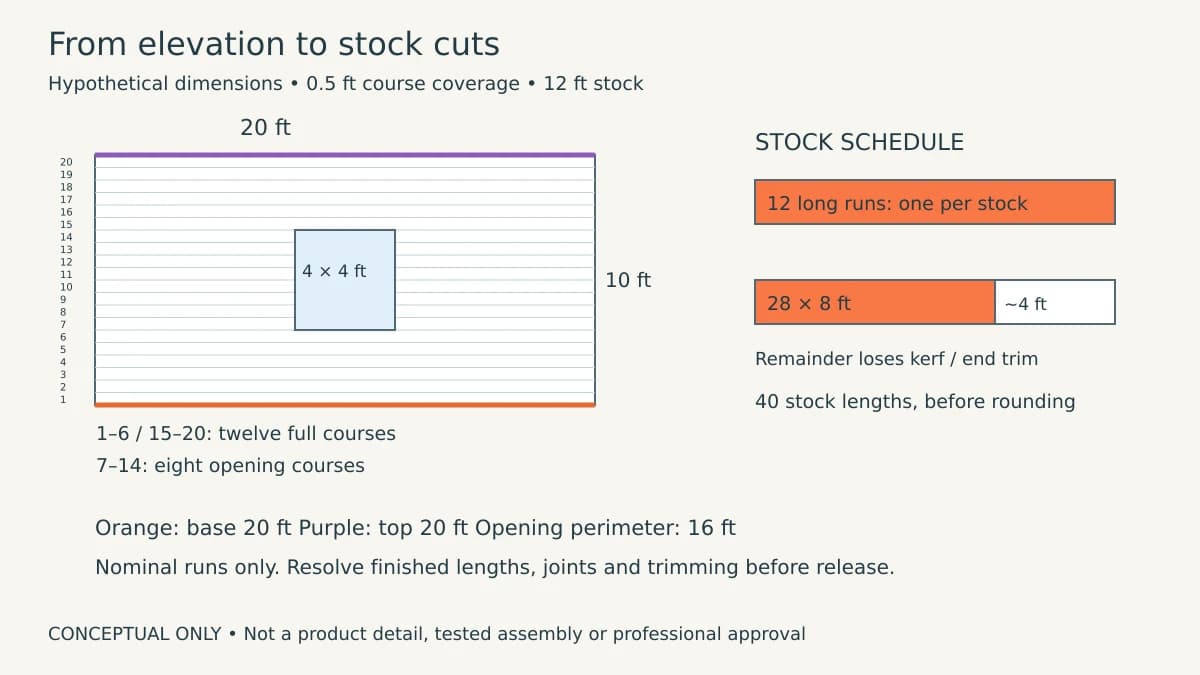
Hypothetical geometry only—not Barcode profile dimensions or an approved fixing layout. Take a wall 20 ft wide by 10 ft high with one centered 4 ft by 4 ft opening, its sill 3 ft above the base. For this exercise only, assume horizontal courses with 0.5 ft effective coverage and 12 ft stock. Assume the opening aligns exactly with course boundaries, there are no panel-clad returns, and an approved joint strategy permits the splits described below. Gross area is 200 sq ft; deduct 16 sq ft for 184 sq ft net. Dividing by 6 sq ft per stock length gives 30.67, rounded to 31 stock lengths as an area-only lower bound. This is not yet a purchasable cut schedule.
| Input or check | Example value | Calculation |
|---|---|---|
| Gross wall | 20 ft × 10 ft | 200 sq ft |
| Opening | 4 ft × 4 ft | 16 sq ft deducted |
| Net panel area | No returns in example | 184 sq ft |
| Course count | 10 ft / 0.5 ft | 20 courses |
| Opening courses | Courses 7–14 | 8 split courses |
| Full-width courses | 1–6 and 15–20 | 12 courses |
Turn the Elevation Into an Order-Ready Cut List
Opening Deductions, Reveals and Returns
The 12 full-width courses each need a nominal 12 ft plus 8 ft run. The eight opening courses each need two nominal 8 ft runs. That produces 12 pieces near 12 ft and 28 pieces near 8 ft: 40 pieces in total. Assign one piece to each 12 ft stock length, so this illustrative layout needs 40 stock lengths before separately agreed spares or package rounding, rather than the area-only count of 31. No second 8 ft piece fits in the approximately 4 ft remainder. A different stock length or approved joint layout could change the result substantially.
These are nominal run lengths, not saw settings. Before release, replace them with finished cuts allowing for approved movement joints, end engagement, kerf and end-trim loss. A nominal 12 ft run cannot demand a finished 12 ft piece from stock that must be end-trimmed. Resolve that by changing stock length or an approved joint arrangement—not by silently shrinking movement clearances. The released schedule must identify course, piece ID, finish direction, finished cut length, stock assignment and drawing revision.
| Course group | Nominal runs | Pieces | 12 ft stock lengths |
|---|---|---|---|
| 1–6 and 15–20 | 12 ft + 8 ft per course | 12 long + 12 short | 24 |
| 7–14 around opening | 8 ft + 8 ft per course | 16 short | 16 |
| Total before package rounding | 368 installed linear ft | 40 pieces | 40 |
Offcut Reuse and Package Rounding
Forty 12 ft lengths contain 480 linear ft; nominal installed runs total 368 linear ft. The 112 linear ft difference is uninstalled stock before detailed cutting allowances, not an instruction to add another waste percentage. The 28 short-piece cuts each leave roughly 4 ft less kerf/end trimming. Reuse an offcut only where its usable length, finish direction, profile and approved joint position match another scheduled piece. Do not assume an exact 4 ft return fits a remainder shorter than 4 ft. If the supplier hypothetically sells six-length bundles, 40 required lengths round to seven bundles, or 42 lengths. That pack size is an example, not a Barcode packaging claim. Record the extra two lengths as package overage before adding any separately authorized spares.
Count Trims, Supports, Clips and Fasteners Separately
Attachment Quantities From the Approved Layout
For the example, the opening perimeter is 16 ft: a 4 ft head, a 4 ft sill and two 4 ft jambs. That is four detail categories, not necessarily 16 ft of a single J-channel product. Base and top runs are each 20 ft; each exposed side termination is 10 ft. An optional adjacent outside corner 10 ft high needs 10 linear ft of a one-piece corner cap, not 20 ft merely because it has two faces. Add laps, miters and stock rounding by accessory. Returns, flashing end dams and corners may require fabricated pieces rather than straight trim.
Keep a separate attachment worksheet with columns for pressure region, connection ID, approved drawing, number of clip locations, fasteners per connection, support lengths and backup anchors. Sum approved quantities by hardware SKU and round packs only afterward. Until that layout exists, mark hardware quantities pending; do not derive them from the arithmetic elevation above. Final release requires coordinated opening dimensions, verified product coverage, supplier stock confirmation, approved attachment details, resolved cut allowances and a responsible reviewer’s sign-off.

About the author
Jay Zdun
Founder, Barcode Cladding
Jay Zdun is the founder of Barcode Cladding. He specializes in aluminum façade systems and helps architects, builders, and property owners evaluate profiles, finishes, and installation considerations for modern exterior projects.
Connect on LinkedIn