
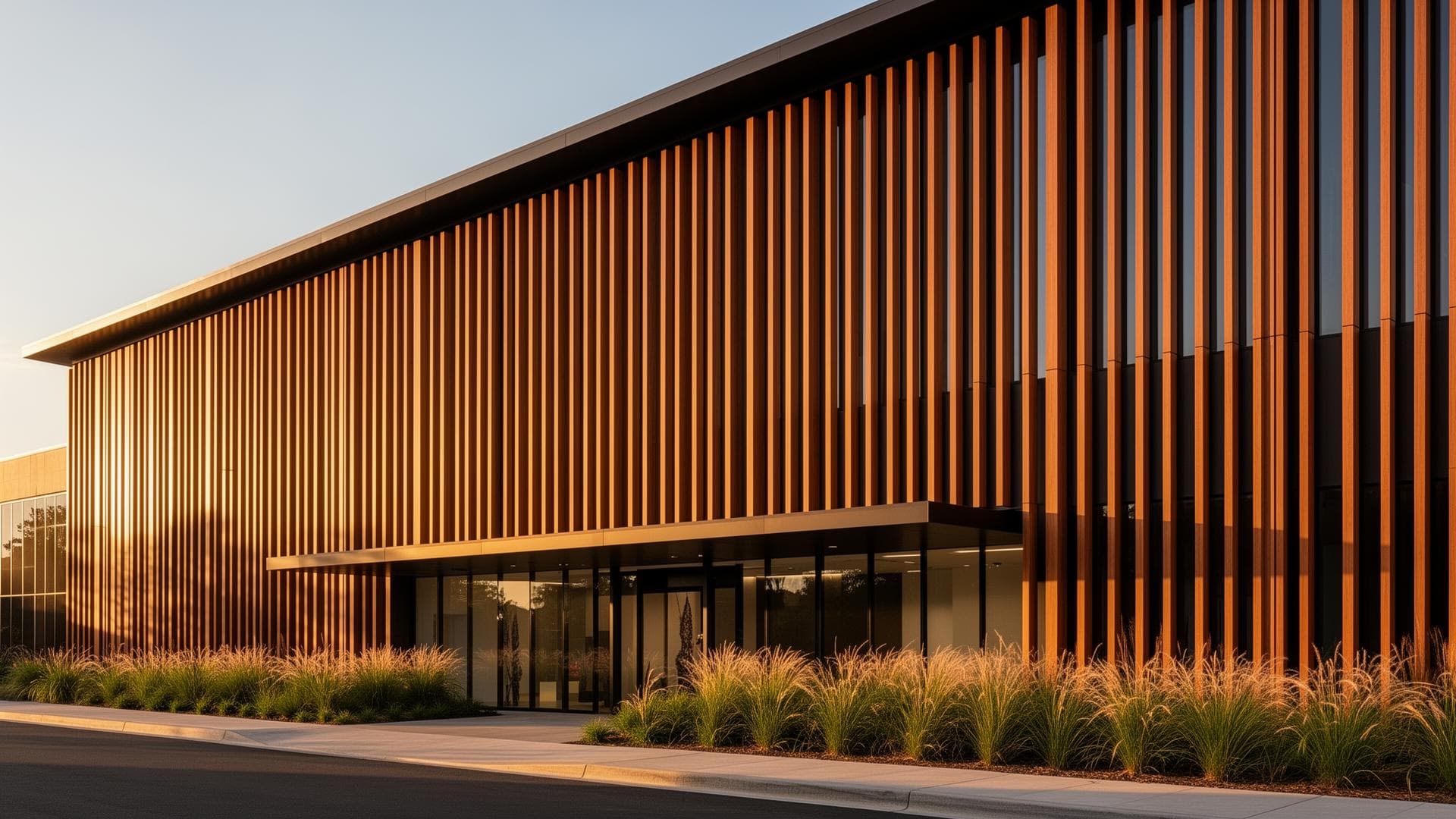
A screen exposes more edges and sides than a continuous wall. Compare timber and aluminum around that exposure, the desired appearance and the owner's maintenance access—not a universal lifespan or price claim.
Key Takeaways
- Compare the exact timber species/treatment and aluminum section/finish, not broad material labels.
- A screen exposes ends, edges and reverse faces that need deliberate detailing and maintenance access.
- Aluminum avoids biological decay but still needs appropriate finish care, connections and corrosion detailing.
- Use a weighted project brief and a representative mockup rather than a universal winner.
Timber and aluminum can both create a repeated exterior screen, but their material behavior and upkeep are different. This guide concerns exposed battens rather than continuous siding. Start within the exterior cladding systems selection framework, then decide whether the screen is primarily decorative, controls views or performs another separately designed function. Neither timber nor aluminum becomes a compliant guard, shading device or structural screen simply because it is sold as a batten.
Specify What You Are Actually Comparing
For timber, identify species, grade, treatment where needed, section, moisture condition and finish. Natural variation can be desirable, but it must be acceptable within the procurement and appearance criteria. For aluminum, identify section geometry, wall construction, finish and connection method. A hollow rectangular extrusion, an elliptical section and a solid wood member should not be treated as mechanically equivalent because their front faces look similar. The Barcode aluminum batten range includes Standard, Elliptical and Dome families, giving a shape choice as well as a finish choice.
Follow Water Around the Whole Batten
Timber exchanges moisture with its surroundings and can change dimensions as its moisture content changes. The USDA Wood Handbook explains why drying, handling, storage and in-service moisture conditions matter. Species, grain direction, detailing and exposure influence the result; one generic movement allowance is not adequate. Pay attention to end grain, cut ends, fixing locations and water trapped at supports. Aluminum does not experience biological rot, but wet crevices, incompatible materials, damaged finishes and unsuitable connections can still create deterioration. Both options need drainage rather than pockets that hold water.
| Decision | Timber battens | Aluminum battens |
|---|---|---|
| Dimensional behavior | Review moisture response, grain direction and conditioning | Review temperature movement and selected connection details |
| Appearance | Assess natural grain, knots, color variation and weathering | Assess section shape, coating variation and cut/end treatment |
| Care access | Plan inspection and any required coating renewal on exposed faces | Plan cleaning, coating inspection and approved repairs |
| Connections | Match fixings and details to species, treatment and exposure | Match fixings and interfaces to extrusion, finish and exposure |
| Replacement | Check ability to source matching section, species and finish | Check ability to source matching section and finish batch |
Compare a Maintenance Route, Not a Maintenance-Free Claim
Draw how a worker would reach the back of the screen, the top ends and the support interfaces. A narrow gap may make the outward face easy to clean while leaving the reverse face inaccessible. Timber may require coating renewal if a maintained coated appearance is part of the design. Some projects deliberately accept natural weathering instead; that is a specification decision, not evidence that all species can be left untreated in every exposure. Aluminum also needs a finish-specific care plan, particularly where contaminants accumulate. Record safe access costs alongside cleaning or refinishing tasks rather than promising a fixed maintenance interval.
Test Appearance From the Occupied Space
Compare real samples at the proposed orientation, under daylight and the lighting used behind the screen. For timber, approve a range of natural variation rather than only a selected flawless piece. For aluminum, review the actual finish and how the shape changes highlights on its sides. Check both straight-on and oblique views using the batten privacy and spacing study. A wood-look finish offers a wood-grain appearance, not an identical tactile surface or natural weathering process. Record which differences the owner accepts before ordering.
Use a Weighted Decision Sheet
Give each project criterion a priority before choosing the material. In the hypothetical worksheet below, a difficult-to-access elevated screen gives maintenance access a high priority. A sheltered, hand-reachable courtyard screen might prioritize natural material character instead. Score actual supplier proposals against documented criteria; do not award aluminum or timber a fixed score without evidence. Separate compulsory requirements from preferences: a missing structural or fire-performance requirement cannot be outweighed by a strong appearance score.
| Criterion | Priority to assign | Evidence to request |
|---|---|---|
| Required structural and regulatory performance | Pass/fail | Evidence for the exact installed assembly and use |
| Appearance and aging | Owner-selected weight | Approved sample range and representative mockup |
| Access for care | High if elevated or obstructed | A realistic access and maintenance method |
| Initial installed scope | Project-selected weight | Like-for-like quantities, supports, finishes and freight |
| Repairability | Owner-selected weight | Removal procedure and replacement supply plan |
Turn the Choice Into a Complete Supply Request
Avoid comparing a loose timber member price with a complete finished aluminum package. Include supports, finishing, end treatment, accessories, fabrication, delivery and installation responsibilities on both sides. If aluminum is shortlisted, the batten installation-planning checklist identifies what must be resolved beyond the decorative face. Barcode Cladding supplies directly from the manufacturer, so a project discussion can connect profile and finish selection with material quantities and shipping arrangements. That access is useful for resolving scope, but it is not a promise of lower installed cost or a substitute for project design.
Frequently Asked Questions
Are aluminum battens maintenance-free?
No. They avoid biological wood decay, but finishes, attachments and drainage still require appropriate inspection and care.
Will timber battens always warp?
No. Performance depends on species, grade, grain, moisture conditions, section and detailing. Specify and handle the actual product appropriately rather than assuming inevitable failure.
Are aluminum battens always cheaper?
No universal cost comparison is supported here. Compare complete installed scope and the project's maintenance-access requirements using current quotes.
Can wood-look aluminum replace any timber screen design?
Not without reviewing section geometry, connections, loads and the intended use. Similar appearance does not make two assemblies interchangeable.
Sources & Further Reading

About the author
Jay Zdun
Founder, Barcode Cladding
Jay Zdun is the founder of Barcode Cladding. He specializes in aluminum façade systems and helps architects, builders, and property owners evaluate profiles, finishes, and installation considerations for modern exterior projects.
Connect on LinkedIn